Picks
The Best Pool Cue Racks
A cue rack is the only accessory that competes with the table for space. Pick the wrong format and you have built a permanent obstacle on the one side of the room that already had none.
How these picks were made: from published manufacturer specifications, governing-body standards and the room arithmetic - not from first-hand use. We have not played on these tables. Read the method.
Nobody plans a cue rack. The table arrives, the cues get leaned against a wall, one of them warps over a winter of being stood at an angle in a damp basement, and only then does anyone go looking. That is a shame, because a cue rack is the one accessory whose correct choice is determined entirely by a measurement you already took when you worked out whether the table would fit.
There are three formats and they take their space from three different places. A wall rack takes wall. A floor rack takes floor, in the one zone that has to stay outside the cue swing. A corner rack takes the dead triangle where two walls meet, which is usually the only unclaimed space in the room. Pick by which of those three you actually have spare, and the rest is finish and capacity.
Why a leaning cue is a real problem
A cue stored leaning against a wall is resting on two points with its own weight pulling on everything in between, and a maple shaft left like that in a room with swinging humidity will take a set. Once a shaft is bowed it cannot be straightened reliably, and a bowed shaft rolls visibly on the table bed - which is the standard way to check a cue and the standard way people discover theirs is finished.
Storing a cue vertically, hanging from the shaft or standing in a cup, loads it along its own axis instead. That is the entire mechanical argument for a rack, and it is why the cheapest rack on this page beats no rack by a much wider margin than the dearest rack beats the cheapest. If your room's humidity swings hard - an unconditioned garage, a basement without a dehumidifier - that argument gets stronger, and the cue buying guide covers the shaft materials that shrug it off.
Quick picks
| # | Product | Best for | Format | Price |
|---|---|---|---|---|
| 1 | Viper Traditional 8-Cue Wall Rack | A room with one spare wall | Wall, 8 cues, two-piece | |
| 2 | 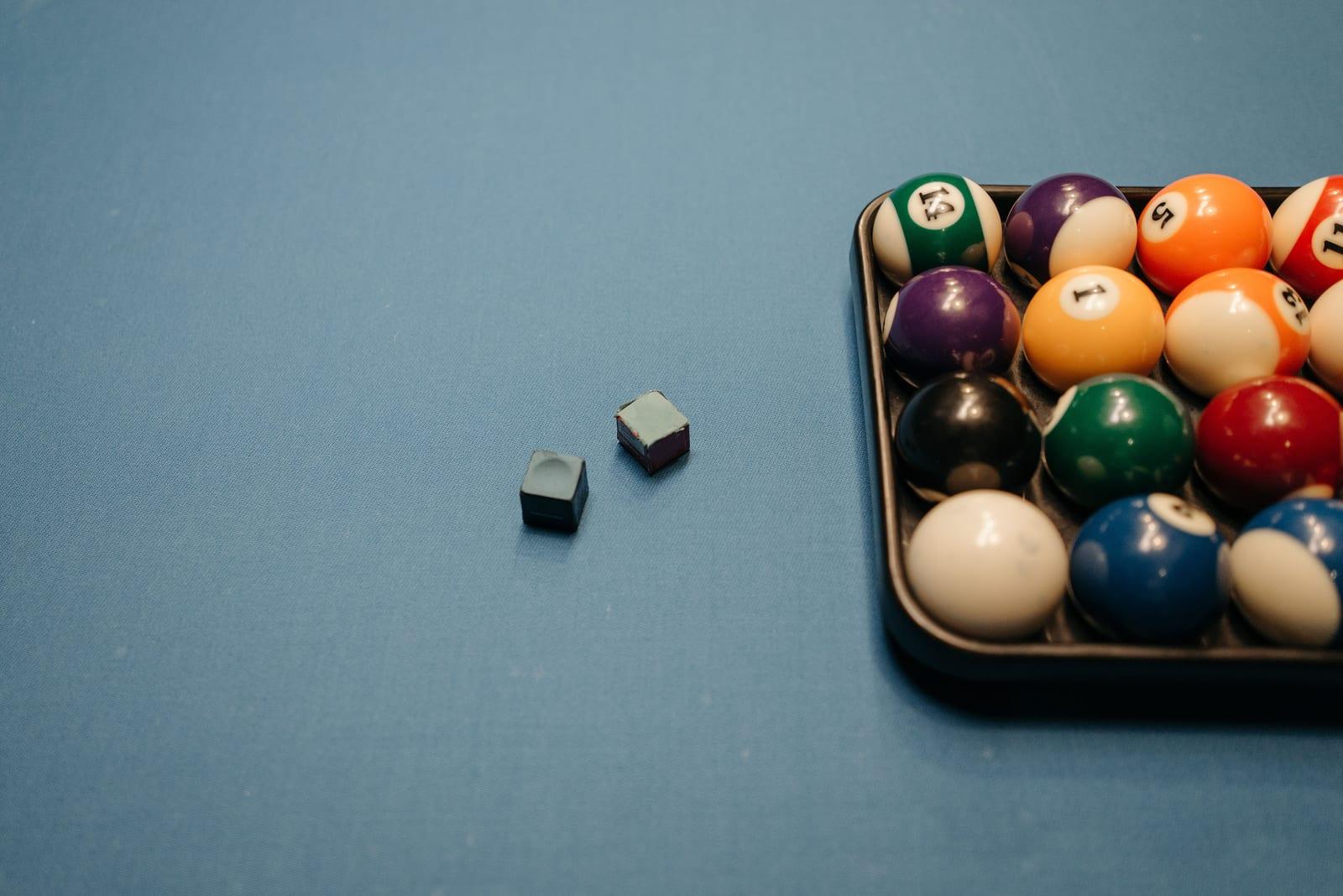 GSE 8-Cue Wall-Mount Rack with Score Counter | The cheapest way to get cues off the floor | Wall, 8 cues, score counter | |
| 3 | 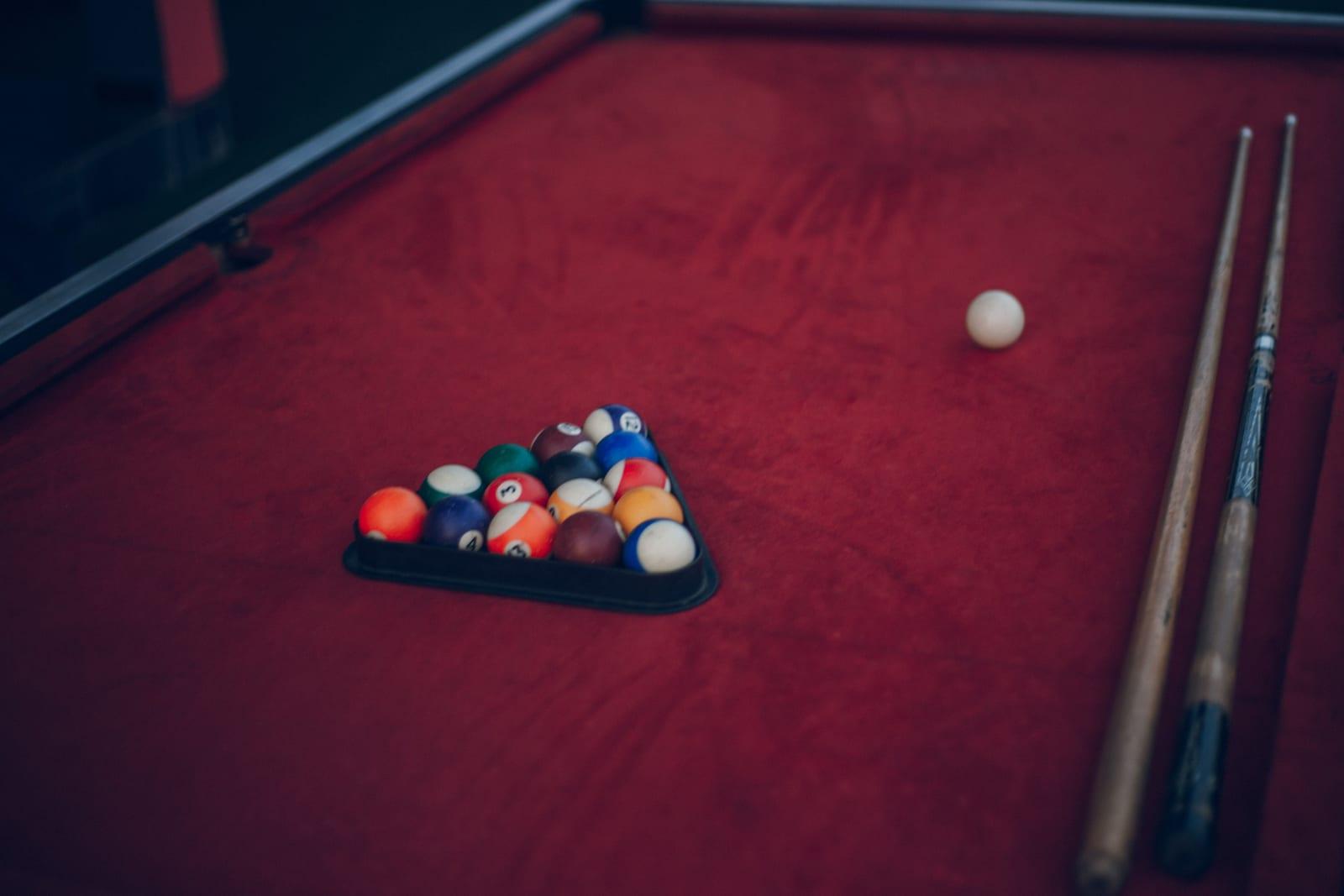 Hathaway Classic Floor Billiard Cue Rack | A rack that also holds everything else | Floor, 10 cues, 28 in tall | |
| 4 | Hathaway Deluxe Floor Cue Rack | Storing two triangles and a full ball set | Floor, 8 x 57 in cues | |
| 5 | Hathaway Regent Corner Floor Cue Rack | A room where every wall is already taken | Floor, corner profile |
The racks
Five racks across the three formats that exist, ordered by the space they take rather than by price: two wall racks, two rectangular floor stands and the corner rack that fits where nothing else does.
#1 · A room with one spare wall
Viper Traditional 8-Cue Wall Rack
A two-piece wood wall rack for eight cues, sold in oak and mahogany. The default answer when you have a spare wall.
The default cue rack, and for most rooms the correct one. It is a two-piece wood rack - an upper strip with clips for the shafts and a lower strip with cups for the butts - so the cues hang vertically against the wall and take almost no floor area. Viper is the billiards line from GLD Products, which is the same group behind several of the tables and dart cabinets elsewhere on this site, and it is sold in oak and mahogany finishes through general sporting-goods retailers as well as billiards specialists. Eight cues is more than most homes own, which is the point: there is room for two short cues alongside the full-length ones.
- What works
- Takes essentially zero floor area, which is the whole argument for a wall rack
- Two-piece design means you set the spacing to your own cue length rather than accepting a fixed box
- Holds eight, so full-length and short cues can live side by side
- What does not
- Needs a wall you are willing to drill, which rules out a lot of rented and finished basements
- Vertical cues stick out from the wall at head height - a bad idea on a narrow walkway
- No storage for chalk, a brush or balls; it holds cues and nothing else
Skip it if: every wall is already taken by a dart board, a TV or a window. That is what the corner rack below is for.
#2 · The cheapest way to get cues off the floor
GSE 8-Cue Wall-Mount Rack with Score Counter
The cheapest format in the category: two hanging strips for eight cues with a sliding score counter on the upper piece.
The budget pick, and an honest one: the same two-strip hanging format as the Viper, in a plainer finish, with a sliding score counter built into the upper piece. GSE Games & Sports Expert is a marketplace brand rather than a billiards house, and the finish is where you can tell - but a rack's job is to hold a cue straight, and a cheap one does that as well as an expensive one. The score counter is the sort of feature that sounds like filler and turns out to get used every time two people play more than one rack.
- What works
- The least expensive format in the category by a clear margin
- Sliding score counter on the top strip, which is genuinely used in practice
- Same low-profile wall footprint as the pricier wood racks
- What does not
- Finish and hardware are plainly cheaper than the branded wood racks
- Stock on specific GSE rack variants comes and goes at individual retailers
- Marketplace listings for this style vary in quality under near-identical photos - check the seller
#3 · A rack that also holds everything else
Hathaway Classic Floor Billiard Cue Rack
A free-standing hardwood rack listed at 10.25 by 29 by 28.25 inches, for up to ten cues plus chalk, brush, a ball set and drinks.
The free-standing answer, and the one to buy if the rack is also supposed to solve the chalk-and-brush problem. Hathaway lists it at 10.25 by 29 by 28.25 inches and rates it for up to ten cues plus chalk, a table brush, a full set of billiard balls and drinks - which is the real reason people buy a floor rack rather than a wall rack. It is also the reason to measure first: 29 inches of wall-side floor is a genuine bite out of a tight room, and it has to sit outside the cue swing on every side of the table.
- What works
- Holds ten cues plus chalk, brush, a full ball set and drinks in one object
- No drilling, so it works in a rented room or a finished basement wall you will not touch
- Published dimensions, which is what lets you check it against your own clearance before buying
- What does not
- Takes about 10 by 29 inches of floor that has to be outside every cue swing
- At 28 inches tall it is exactly the height to catch a hip in a dark room
- Nothing stops it being knocked over except its own weight
Skip it if: your short side is already under the 64 inches a 58-inch cue needs. A floor rack makes a tight side tighter.
#4 · Storing two triangles and a full ball set
Hathaway Deluxe Floor Cue Rack
Listed for eight 57-inch cues, a full ball set and two triangles. The floor rack that swallows the whole accessory drawer.
The step up in the same family, listed for eight 57-inch cues, a full set of billiard balls and two triangle racks. The triangles are the detail worth noticing: a wooden triangle has nowhere good to live and ends up either hanging off a pocket or leaning on the wall behind the table, and a rack with a slot for two of them removes a small, permanent annoyance. Same caveat as the Classic, in the same words: it is furniture, and furniture in a game room has to be outside the swing.
- What works
- Dedicated storage for two triangle racks, which almost nothing else provides
- Takes a full ball set as well as the cues, so the accessory drawer empties into it
- Rated specifically for 57-inch cues, so the slots are the right depth rather than generic
- What does not
- Eight cues rather than the Classic's ten, despite being the dearer rack
- Same floor-area and knee-height problems as any floor stand
- Finish options and availability vary by retailer within the same model number
#5 · A room where every wall is already taken
Hathaway Regent Corner Floor Cue Rack
A corner-profile floor rack, which is the one shape that fits a room where every wall is already spoken for.
The format that solves the problem the other four cannot. A corner rack has a triangular footprint built to sit into a 90-degree corner, which is the one piece of floor in a game room that is almost always dead: it is outside the cue swing on both of the sides that meet there, and nothing else wants it. If your room has a dart board on one wall, a TV on another and a window on the third - which is most basements - this is the rack that fits. It is the right answer for a surprising number of rooms and almost nobody shops for it.
- What works
- Uses corner floor that is already dead space on both adjoining sides
- No drilling and no wall required, so it survives a room you cannot modify
- Keeps cues and accessories together like the other floor racks
- What does not
- Only works if you actually have an accessible corner - a staircase or a door kills it
- Smaller capacity than the big rectangular floor racks
- The narrowest retail availability of the five here; it is a lower-volume shape
Skip it if: the nearest free corner is across the room from the table. A rack you walk to is a rack that stays empty.
How these were chosen
We have not mounted these racks or load-tested them, and this site publishes no scores, star ratings or review counts, because we have not tested anything and will not imply that we have. Every capacity, format, dimension and material claim below came from the manufacturer's or a stocking US retailer's own published listing, each checked as currently sold while this page was written.
- The format is named first. Wall, floor or corner. It is the only decision that cannot be undone by buying a different finish.
- Capacity is published. Eight cues, ten cues, eight 57-inch cues. A rack sold without a stated capacity cannot be matched to the cues you own.
- Dimensions where the maker gives them. A floor rack's footprint is the number that decides whether it fits, and the Hathaway Classic is the one here that publishes it.
- One rack per room problem. Spare wall, no budget, nowhere to put the chalk, nowhere to put the triangles, no spare wall at all. Five problems, five racks.
- No weight-capacity claims. Retail listings for racks in this category rarely publish a tested load, so none is quoted as fact here.
Wall racks: the mounting is the whole job
A two-piece wall rack is two strips of wood and a handful of screws, and the only thing that can go wrong is what you screw them into. Eight cues is not heavy, but the load is concentrated on four or six fixings and it is a load that gets knocked sideways every time somebody pulls a cue out in a hurry. Into a stud it is a ten-minute job that lasts decades. Into bare drywall with the screws that came in the bag, it is a slow-motion failure.
The two-piece layout also means you choose the vertical spacing, which matters more than it sounds. Set the strips for a 58-inch cue and a 52-inch short cue hangs loose in the clips; set them for the short cue and the long ones bottom out. If you own both - and in a tight room you should - mount the rack for the full-length cues and accept that the short ones sit a little high in the cups.
And give some thought to where in the room the cues end up pointing. A rack on a wall that people walk along puts butt ends at hip height and tips at head height in a dim room. The wall behind the short side of the table, where nobody stands because nobody can shoot from there anyway, is usually the right one.
Floor racks: furniture, with the rules furniture has
A floor rack is a piece of game room furniture and the standing rule for game room furniture applies: it must be outside the cue swing or able to move in two seconds. A loaded floor rack does not move in two seconds. So it gets placed once, and it has to be placed correctly the first time.
The payoff is that a floor rack is the only format that solves the small-items problem. Chalk, a brush, a triangle, a spare ball set and a cue extension all have to live somewhere, and in most game rooms they live on the rail of the table itself, which is the one place they absolutely should not. A rack with cups and shelves is how that stops. The accessories page covers what is worth owning in the first place, and the seating page covers the same move-it-or-lose-it rule for stools and sofas.
| Format | Space it takes | Needs drilling | Holds accessories |
|---|---|---|---|
| Wall rack | Wall only; a few inches of depth | Yes | Rarely |
| Floor rack | Roughly 1 by 2.5 ft of floor, outside the swing | No | Yes |
| Corner rack | Dead corner floor, outside both swings | No | Yes |
| No rack | Nothing, until a shaft takes a set | No | No |
Corner racks: the format nobody shops for
Ask somebody to picture a cue rack and they picture a wall rack. Ask them which wall it is going on and, in a real basement, the answer is often that there isn't one - the dart board has one wall, the TV has another, a window or the stairs has the third, and the fourth is where the table's short side already is. That is the room a corner rack exists for.
The reason it works is geometric rather than clever: the floor in a 90-degree corner is already outside the cue swing on both of the sides that form it, so a triangular footprint placed there costs you nothing you were using. It is the same logic the narrow basement and 10 by 12 basement pages apply to everything else in a tight room, and it is why a corner rack belongs on the shortlist of anyone whose room measurement came out marginal.
What a rack does not fix
It does not protect a cue from the room. A rack stops a shaft bowing under its own weight; it does nothing about a garage that swings from 40 to 90 degrees across a year, and a maple shaft stored perfectly in those conditions can still move. If that is your room, the answer is a fiberglass or composite shaft rather than a better rack - which is one of the few genuinely climate-driven equipment decisions in a game room, alongside the climate adjusters on a shuffleboard table.
It also does not make a tight room workable. If a side of your table is under the clearance a cue needs, the fix is short cues on that side, not a different rack - and short cues need somewhere to live too, which loops back to buying the eight-cue rack rather than a four. 58-inch versus short cues is the page for that decision.
Prices, and why there are none on this page
Racks are a low-price, high-promotion category: the same model appears at several retailers at several prices in the same week, and the marketplace listings move constantly. A printed number here would be wrong by the time you read it, so every button goes to the live listing instead. In rough brackets: a plain hanging wall strip set is the cheapest item on this page by some distance, a branded wood wall rack is a low two-figure purchase, and the floor and corner racks sit in the middle two figures.
What we have not done
We have not mounted, loaded or lived with these racks. Every format, capacity, dimension and finish above is from a manufacturer's or stocking US retailer's published listing, checked as currently sold while this page was written. The judgments - that the format decision is the only one that matters, that a wall rack belongs on the wall nobody shoots from, that a corner rack is the overlooked answer in a basement - follow from the clearance a 58-inch cue needs and from how the three shapes take their space. Where a figure could not be verified, it is not on this page.
Questions people actually ask
How many cues does a home pool table need?
Should I buy a wall cue rack or a floor cue rack?
How much space does a pool cue rack need?
Does it matter how you store a pool cue?
What do you screw a wall cue rack into?
Is a corner cue rack worth it?
Can a cue rack hold short cues and full-length cues together?
Sources
- World Pool-Billiard Association - Rules of Play (equipment and lighting specifications)
- Hathaway Games via Target - Classic Floor Billiard Cue Rack (published dimensions and capacity)
- Zoro - Hathaway Deluxe Floor Cue Rack BG2565W (capacity for eight 57-inch cues, ball set and two triangles)
- Target - Viper Traditional two-piece wall billiard cue rack (GLD Products)