Picks
The Best Foosball Tables for Small Rooms
A foosball table's cabinet is not its footprint. The rods slide out of both sides while you play, and on a through-rod table that is another two feet of room you have to own.
How these picks were made: from published manufacturer specifications, governing-body standards and the room arithmetic - not from first-hand use. We have not played on these tables. Read the method.
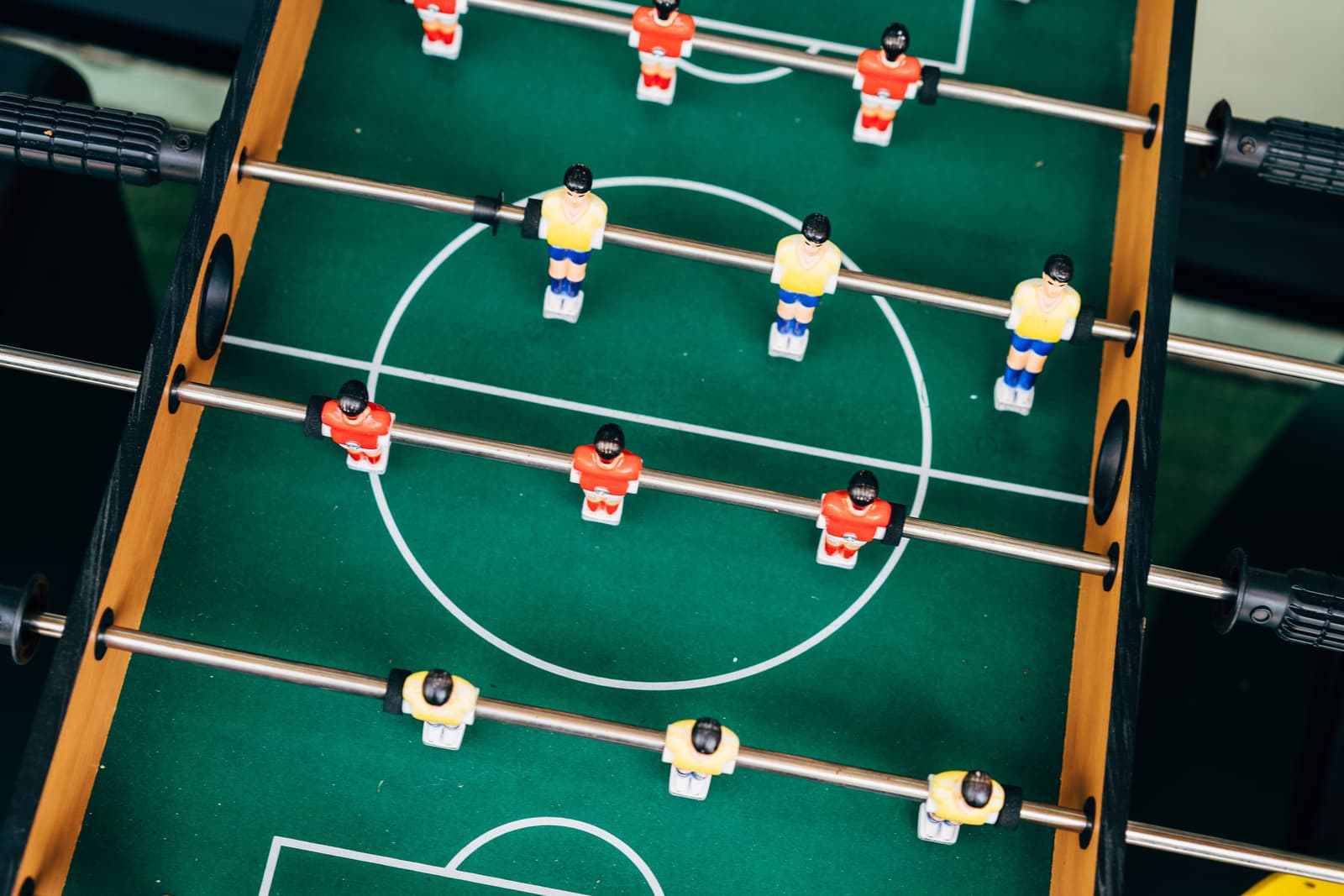
Foosball is the game room purchase people get wrong on measurement more than any other, and it is not because the cabinets are large. It is because the rods move. Each rod has to travel far enough for its outermost man to reach the far side of the pitch, and on a through-rod table that travel goes somewhere: out of the opposite side of the cabinet, about 12 to 15 inches of it, at roughly 36 inches off the floor. Measure the cabinet, buy the table, and you find out the hard way that the room needed another two feet it does not have.
So a small-room foosball table is not simply a short one. There are three real ways to get a playable table into a tight space, and they are different purchases: shrink the cabinet, remove the rod travel with telescoping rods, or make the table go away between games. The picks below are organized around those three, not around price.
Measure at rod height, not at the floor
This is the measurement that catches people. Rod extension happens at about 36 inches off the floor - counter height. A radiator, a window sill, a workbench, a stair stringer or a kitchen counter at that height blocks the rods completely even though the floor underneath it is clear and your tape measure says the table fits. Walk the room at 36 inches with your arm out before you order anything.
| Format | Cabinet L x W | Rod extension | Floor needed | Plus standing room |
|---|---|---|---|---|
| Regulation, through rods | 56 x 30 in | 12-15 in per side | 56 in x 5 ft | 2 ft at each end |
| Regulation, telescoping | 56 x 30 in | none | 56 x 30 in | 2 ft at each end |
| Compact / family | 48-54 x 26-29 in | 10-13 in per side | ~50 in x 4 ft 6 in | 2 ft at each end |
| Tabletop | ~36 x 20 in | 6-8 in per side | ~36 in x 3 ft | standing room only |
The standing room is not optional and it is not negotiable down. Nobody plays foosball pressed against the end of the cabinet - the game is played leaning in and pulling back, and two feet behind each goal is the minimum that feels like playing rather than like being stuck in a corner. The full dimensions and clearance page works through the arithmetic, including why the five-man rod rather than the goalie rod sets the clearance figure.
Telescoping rods are the real small-room feature
A telescoping rod retracts into the cabinet rather than passing out of the far side, which removes the entire clearance problem in one design decision. On a 56-inch regulation table that turns a 56-inch by 5-foot floor requirement into 56 by 30 inches - more floor saved than you get by dropping down to a 48-inch cabinet. If your constraint is width rather than length, telescoping rods beat a smaller table every time.
The honest counterweight: competitive players prefer solid through rods, and they have a case. A telescoping rod has a joint in it, the joint introduces a little flex and a little play, and on a hard shot you can feel both. It is also one more thing to wear out over a decade of use. If you are buying a table to play seriously on, you are buying a through-rod table and you are buying the room clearance that goes with it. The telescoping versus through rods page is the full version of that argument.
Quick picks
| # | Product | Best for | Footprint | Price |
|---|---|---|---|---|
| 1 | 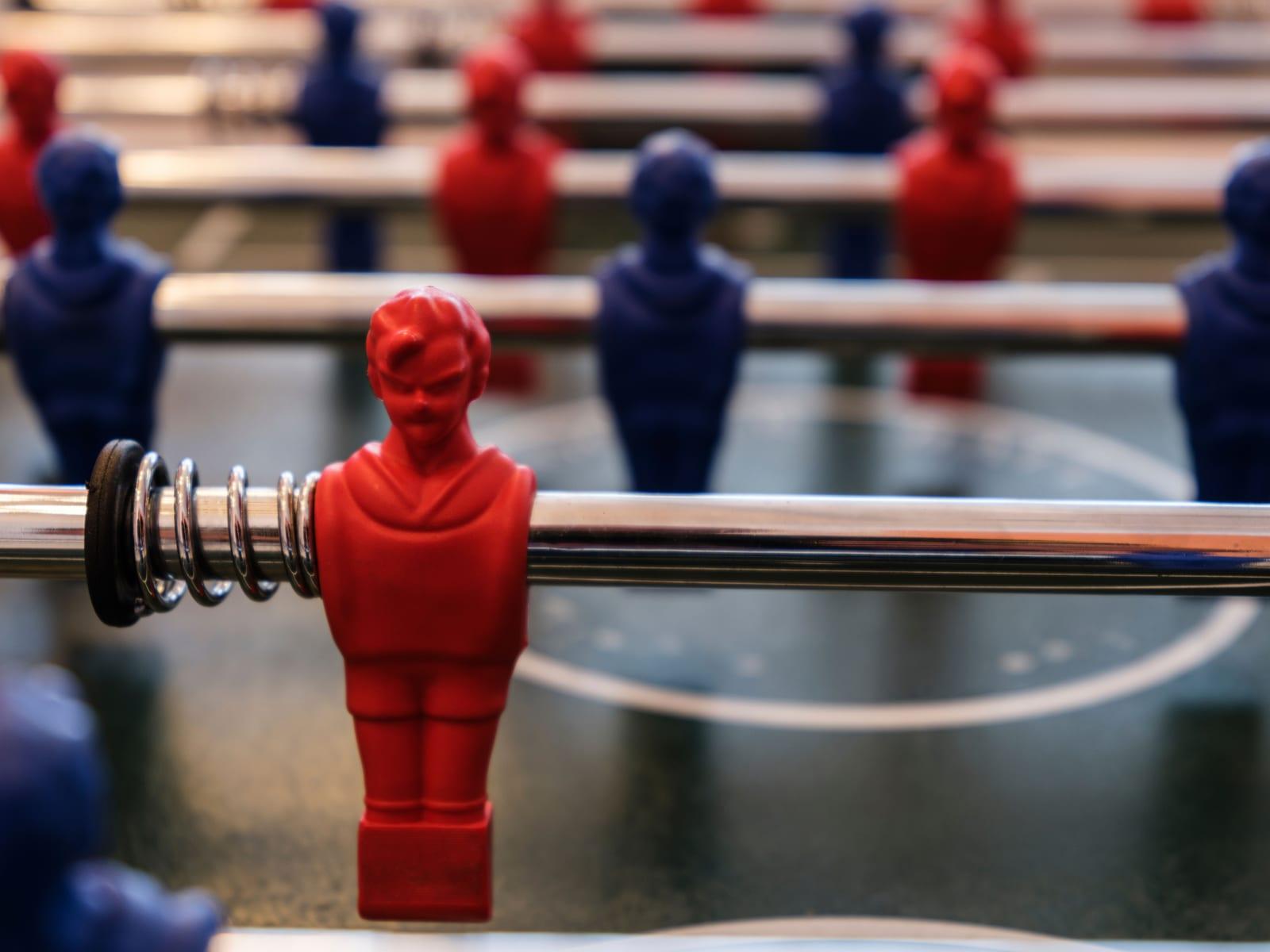 Hathaway Allure 48 in Foosball Table | The tightest room that still gets a real table | 48 in cabinet, retracting rods | |
| 2 | Garlando G-500 Foosball Table | A full-size table in a room with no side clearance | Regulation cabinet, telescoping rods | |
| 3 | Hathaway Gladiator 48 in Folding Foosball Table | A room that has to be a room again afterwards | 48 x 23.75 in, folding legs | |
| 4 | 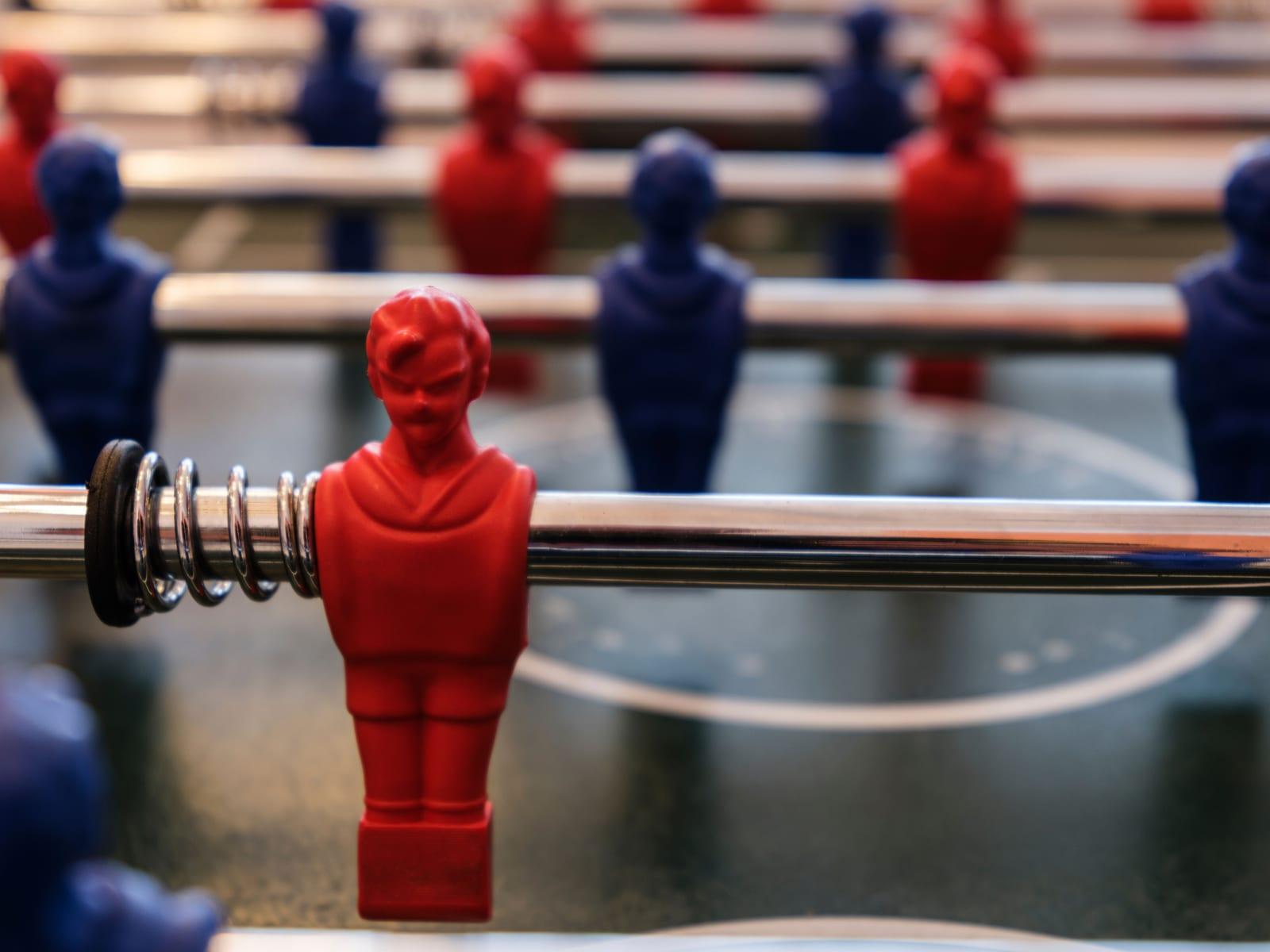 Hathaway Playoff 4 ft Foosball Table | The cheapest way into a real freestanding table | 48.5 x 24 in cabinet | |
| 5 | 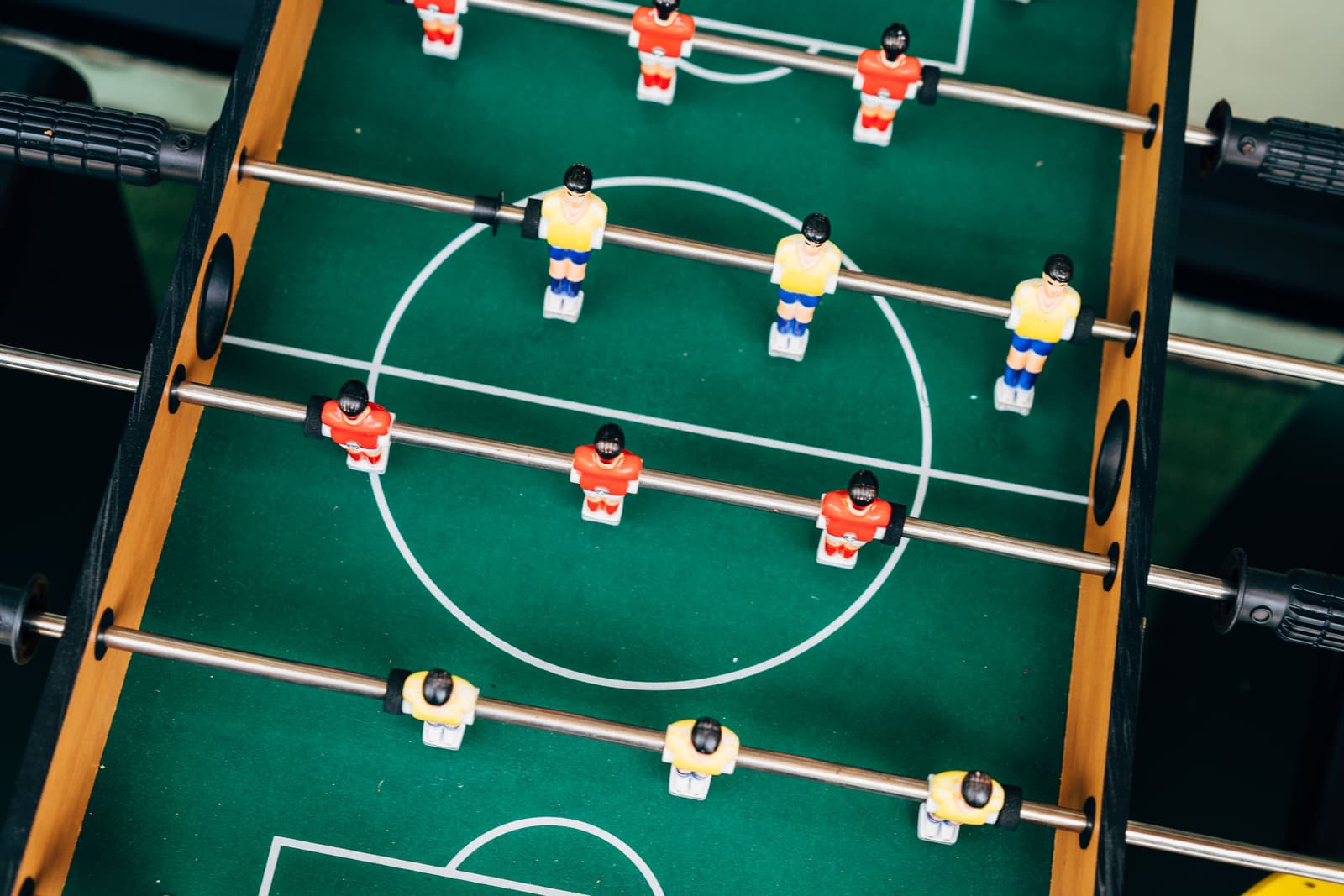 Best Choice Products 48 in Foosball Table | Seeing the real footprint before you buy | 48 x 24 in cabinet, 56 x 42 in in use | |
| 6 | Sport Squad FX40 Tabletop Foosball Table | A room with no floor space left at all | ~36 x 20 in, tabletop |
The tables
Six tables ordered by how well each one solves the clearance problem rather than by price: two that retract the rods, one that folds away, two compact 48-inch cabinets, and the tabletop that needs no floor at all. Every dimension below is the maker's or retailer's published figure.
#1 · The tightest room that still gets a real table
Hathaway Allure 48 in Foosball Table
A 48-inch table listed with spring-loaded telescopic safety rods, so the handles retract into the cabinet instead of standing out from it.
This is the answer to the actual problem. Two things make a foosball table too big for a small room: the cabinet, and the twelve inches of rod that slides out of each side while you play. A 48-inch cabinet fixes the first. Spring-loaded telescopic rods - which Hathaway lists on this table - fix the second, because the rod retracts into the cabinet instead of travelling out through it. Put those together and the table's footprint while in use is close to its footprint standing still, which no through-rod table can claim. The rods are sold as a safety feature, aimed at rooms with children in them, and the space saving is the side effect that matters here.
- What works
- Telescopic rods mean the playing footprint is essentially the cabinet footprint
- 48-inch cabinet, so it fits against a wall a 56-inch table cannot
- No projecting rod ends at child head height, which is the feature it is actually sold for
- What does not
- Telescoping rods have more moving parts than a solid rod and are the thing that eventually wears
- A 48-inch pitch is shorter than regulation, so the game is faster and less tactical
- Serious players dislike telescoping rods on feel grounds, and they are not wrong
Skip it if: you want a competition-feeling table. Telescoping rods and a short pitch are both compromises, and this table makes them both.
#2 · A full-size table in a room with no side clearance
Garlando G-500 Foosball Table
Telescoping rods with chromium plating. The telescoping design is what lets it sit closer to a wall than a through-rod table.
The other way to solve the clearance problem: keep the regulation cabinet and remove the rod travel. The G-500's telescoping, chromium-plated rods retract rather than passing through the far side, which is precisely why a regulation Garlando can sit closer to a wall than a through-rod table of the same size. You are still buying a 56-inch cabinet and still need two feet of standing room at each end, so the floor plan is not small - but the width problem goes away, and a long narrow basement is exactly the room this suits.
- What works
- Regulation pitch with none of the side clearance a through-rod table demands
- Telescoping chromium rods, so one long wall can be a genuine wall rather than a gap
- A properly made European table rather than a flat-pack family one
- What does not
- Still a 56-inch cabinet - it solves width, not length
- Costs several times what the 48-inch tables here cost
- Telescoping rods remain a compromise in feel against a Tornado-style through rod
Skip it if: your constraint is length rather than width. No telescoping rod shortens a cabinet.
#3 · A room that has to be a room again afterwards
Hathaway Gladiator 48 in Folding Foosball Table
Listed at 48 x 23.75 x 32.25 in over a 42.1 x 23.4 in playfield, on folding legs - the one table on this page that leaves the room entirely.
The only table on this page that leaves. Hathaway lists it at 48 x 23.75 x 32.25 inches over a 42.1 x 23.4-inch playfield on folding legs, which means the table that needs a clear floor on game night needs a wall and about two feet of depth the rest of the week. For a spare bedroom, a studio apartment or a dining room that doubles as the games room, that is a different kind of answer from a smaller permanent table - it converts a space problem into a storage problem, which is usually the easier of the two to solve.
- What works
- Folds flat, so a shared room stops being a games room between sessions
- Published playfield figure of 42.1 x 23.4 in, which is a real number rather than a cabinet figure
- Light enough for one adult to move and set up alone
- What does not
- Folding legs are the least rigid support on this page; the cabinet moves more under hard play
- Through rods, so it still wants side clearance while it is up
- A table that has to be set up gets played less than one that is always there
Skip it if: the room is permanently yours. A fixed 48-inch table is more rigid and plays better for the same money.
#4 · The cheapest way into a real freestanding table
Hathaway Playoff 4 ft Foosball Table
Listed at 48.5 x 24 x 32 in over a 40 x 22.75 in playfield, with analog scoring and leg levelers. The cheap way into a real freestanding table.
Listed at 48.5 x 24 x 32 inches over a 40 x 22.75-inch playfield, with analog scoring and leg levelers. The levelers are worth more in a small room than they sound: small rooms are frequently basements and garages, basement and garage floors slope to a drain, and a foosball ball on a sloping pitch dead-rolls to one end all evening. This is the plain, cheap, honest version of a 48-inch table - no telescoping rods, no folding legs, no LED anything - and for a family that wants a table rather than a game, that is the right amount of table.
- What works
- Leg levelers, which matter on the sloped concrete floors small rooms tend to have
- Published playfield figure of 40 x 22.75 in, among the smallest here
- The lowest price of the freestanding tables on this page
- What does not
- Through rods, so budget another foot either side of the 48.5-inch cabinet
- A 40-inch pitch is a long way short of regulation; the game is scrappy
- Analog scoring and lightweight construction - this is a family table and plays like one
Skip it if: your side clearance is the problem rather than your cabinet space. Pay the extra for telescoping rods.
#5 · Seeing the real footprint before you buy
Best Choice Products 48 in Foosball Table
A 48 x 24 in cabinet whose listing quotes 56 x 42 in once the rods and cup holders are counted - the most honest footprint figure in the category.
On this page for a reason beyond the table itself: its listing quotes both figures. The cabinet is 48 x 24 inches, and the listing states 56 x 42 inches once the rods and cup holders are counted - which is the single most useful number in this entire category and almost nobody publishes it. Forty-two inches of width on a 24-inch cabinet is the rod travel made visible, and it is why people measure a wall, order a table, and then find it does not work. As a table it is a competent budget 48-incher with cup holders in the end rails; as a specification it is the honest one.
- What works
- The listing publishes the in-use footprint, not just the cabinet - unique here
- Cup holders in the end rails, which keeps drinks off the pitch
- Among the cheapest 48-inch freestanding tables currently sold
- What does not
- That honest 56 x 42 in figure is also the biggest in-use footprint of the 48-inch tables here
- Marketplace-brand construction: MDF cabinet, lightweight rods, no levelers published
- Cup holders add to the width you have to clear, which is part of why the figure is 42 in
Skip it if: you measured 48 inches of wall and nothing more. Read that second number again before ordering.
#6 · A room with no floor space left at all
Sport Squad FX40 Tabletop Foosball Table
A tabletop unit for rooms with no floor space left. Nobody confuses it with a real table; that is not what it is for.
When there is no floor to give, the table goes on a table. A tabletop unit at roughly 36 x 20 inches needs about three feet of a dining table or a counter, six to eight inches of rod travel each side, and nothing permanent at all - it goes in a closet between games. Nobody confuses it with a real table, and that is not what it is for. What it is for is an apartment, a bedroom or a room where a 48-inch cabinet would have to be moved every time somebody wanted to walk through, and in that room it is the only thing on this page that works.
- What works
- No floor footprint whatsoever - it stores on a shelf or in a closet
- Cheapest item on this page by a wide margin
- A real multi-rod game rather than a toy, within its size
- What does not
- A ~36-inch unit on a dining table puts the pitch at the wrong height for standing adults
- Short rods and light men mean the ball behaves nothing like it does on a full table
- The host table has to be solid, or the whole unit shifts under play
Skip it if: you have 50 inches of wall and four and a half feet of floor. A 48-inch freestanding table is a different game.
How these were chosen
We have not played on these tables, and this site publishes no scores, star ratings or review counts, because inventing them would be the easiest lie in this business. Every cabinet dimension, playfield figure, rod type and folding mechanism below came from the manufacturer's or a stocking retailer's own published listing, each checked as currently sold while this page was written.
- The cabinet dimensions are published. A table sold with no stated length and width cannot be fitted to a room, so it is not here however good it looks.
- The rod type is identifiable. Telescoping or through. This is the single largest factor in how much floor a table needs, and a listing that does not say is a listing that is guessing on your behalf.
- It solves a space problem a different pick does not. Six tables, five mechanisms: retracting rods on a short cabinet, retracting rods on a regulation cabinet, folding legs, a plain compact cabinet, and a tabletop. A page of five near-identical 48-inch tables would be useless.
- Published playfield figures where they exist. Cabinet size tells you what the room needs; playfield size tells you what the game feels like. Where a maker publishes both, both are quoted.
- It is currently sold. Each listing was checked while this page was written, not carried over from an older roundup.
What a 48-inch pitch costs you
Be clear-eyed about this before you spend the money. A regulation pitch is close to 56 by 30 inches of cabinet, and the compact tables here run a 40 to 42-inch playfield. Shorten the pitch and the ball crosses it faster, passes arrive before the receiving rod is set, and the tactical middle of the game - the pass from the two-man to the five-man and the setup shot from there - compresses into a scramble. Short-table foosball is fun. It is a different, more frantic game than the one played on a Tornado.
Height is the other thing a compact table changes. A regulation cabinet stands about 36 inches to the top; the 48-inch tables here are listed at 31 to 32 inches, which is friendlier to a child of eight or nine and slightly low for a tall adult over a long session. If the main players are small children, a tabletop unit or air hockey is usually the better buy, because the reach problem does not resolve itself with practice.
Where to put it in the room you actually have
Foosball is better than most game room tables at living in an awkward space, because the play happens at the two ends. A table down one long wall with its ends free works fine; the same table centered in a square room with its ends against furniture does not. In a narrow basement, that is good news - a foosball table along the length of a corridor-shaped room is close to the ideal use of it. The narrow basement page and the spare bedroom page both work through plans at that shape.
If the room is a garage, add one more check: the rods sit at about 36 inches, and a garage usually has something at 36 inches on at least one wall - a chest freezer, a workbench, a water heater, a car. The table can face into the bay and work perfectly while the car is out and be unplayable the moment it comes back in. The one-car garage plan covers that overlap properly.
If none of these fit
There are two honest fallbacks. The first is a multi-game table, which puts foosball, air hockey and a pool-style game into a single cabinet and gives you one footprint for several games - with the caveat that each game is a compromised version of itself. What multi-game tables actually include is the page to read before buying one, because the listings oversell them.
The second is to pick a different game. Air hockey shrinks more gracefully than foosball does - the playfield is the whole game and nothing projects from the cabinet - so a small room that cannot take a foosball table will often take a decent air hockey table instead. The small-room air hockey roundup is the direct counterpart to this page, and foosball versus air hockey covers which game suits which household.
Prices, and why there are none on this page
Compact foosball tables are a promotional category: the same 48-inch table carries three prices across three retailers in the same week, and stock on the cheapest ones comes and goes. Printing a number would mean printing a number that is wrong next month, so every button here goes to the live listing instead. In rough brackets: the tabletop unit is the cheapest thing on this page by a wide margin, the 48-inch family tables sit together in the low hundreds, and the regulation telescoping-rod table is several times any of them.
What we have not done
We have not played on these tables, measured rod travel with a tape, or run any of them long enough to see which telescoping mechanism loosens first. Every dimension, playfield figure and rod type above is from a published manufacturer or stocking-retailer listing, checked as currently sold while this page was written. The judgments - that rod travel rather than cabinet size is the real constraint, that telescoping rods save more floor than a shorter cabinet does, that a folding table gets played less than a fixed one - follow from the geometry and from how rooms get used. Where a figure could not be verified, it is not on this page.