Guide
Are Foosball Tables Worth It?
Foosball has the best ratio of fun to learning time of any game in a games room, and the highest rate of abandoned tables. Both facts come from the same place: the cabinet.
How these picks were made: from published manufacturer specifications, governing-body standards and the room arithmetic - not from first-hand use. We have not played on these tables. Read the method.
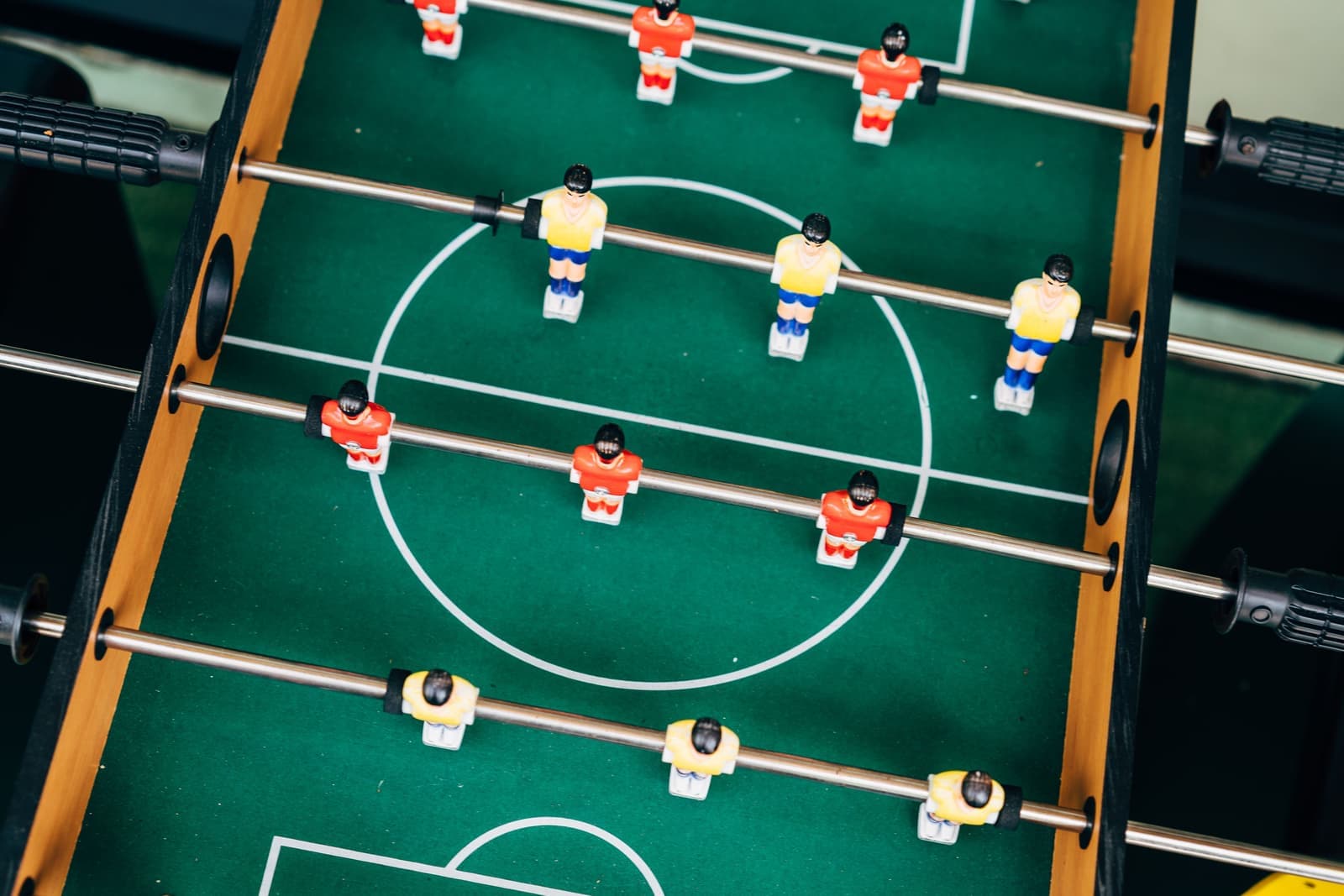
A foosball table is worth it if the cabinet is heavy enough not to move when two adults pull against each other, and if the room has the clearance the rods need - 12 to 15 inches beyond each long side for through-rods, or none at all for telescoping. If both are true, it is the fastest game in a games room to learn and the one most likely to be played by people who did not come over to play anything. If either is false, it gets abandoned, and the usual diagnosis is that nobody liked foosball.
The two reasons foosball tables get abandoned
The first is cabinet weight. Foosball is a game of two people applying force in opposite directions across a box. If the box moves - slides on the floor, rocks on its feet, flexes between the ends - the ball stops going where the geometry says it should, and the game becomes random. Players read this as being bad at foosball rather than as a table problem, and the table slowly stops getting used. A listed weight under about 100 lb is where this becomes noticeable with adults.
The second is rod clearance. A through-rod slides out the far side of the cabinet as you pull, so the real footprint is the cabinet plus 12 to 15 inches at each long side - measured at about 36 inches off the floor, where a window sill or a radiator can block it even though the floor below is clear. Push the table against a wall and you lose the pull on that side entirely - which means one player cannot defend, and a game where one player cannot defend stops being a game. This one is fully solvable at purchase by buying telescoping rods, and almost nobody realizes it is a question until the table is in the room.
| Question | Pass | Fail | What to do about a fail |
|---|---|---|---|
| Cabinet weight | 150 lb and up | Under ~100 lb | Buy heavier, or put it on carpet |
| Clear space beyond each long side | 12-15 in, both sides | Wall on one side | Buy telescoping rods |
| Floor | Carpet or rubber tile | Tile or polished concrete | Add a rug or tiles |
| Noise downstairs | Ground floor or slab | Room above a bedroom | Reconsider - it is the goal bang |
| People who will play | Two or more, regularly | One | Foosball needs two - always |
What foosball is genuinely best at
Two things, and they are worth stating because they are the case in favor. First, the learning curve: a complete beginner is competitive within about ten minutes, which is true of almost nothing else in a games room. Pool punishes a novice for an hour. Darts requires the thrower to already be able to throw. Foosball hands two people who have never played a close game immediately, and that is why it gets played at parties.
Second, the duration. A game of foosball takes five minutes. It fits into the gap between two other things, which means it gets played casually and often rather than ceremonially and rarely - the opposite failure mode to a pool table, which is set up for an evening or not at all. In a household that wants a game people drift into, foosball is the strongest candidate on this site.
Three tables for three answers
The regulation table that makes the answer yes, the telescoping-rod table for a room that said no, and the tabletop unit for when you suspect the honest answer is no.
#1 · The table that answers yes
KICK Legend 55 in Foosball Table
A regulation-size wood-frame table that ships with both uniformed and counterbalanced men and a one- or three-rod goalie option.
A regulation-size wood-frame table that ships with both uniformed and counterbalanced men and a one- or three-rod goalie option. This is the honest center of the market and the table that makes the answer yes for most households: full-size geometry, a wood cabinet heavy enough to stay still under adult play, and the men and goalie options that let the table match how your household actually plays. It is the point at which a foosball table stops being a toy.
- What works
- Regulation size, so the game is the real game
- Both men types and two goalie configurations in the box
- Heavy enough to stay put without being a commercial install
- What does not
- Through-rods, so it needs clearance at both ends
- Lighter than a commercial table - hard play will shift it on a hard floor

#2 · When the room says no
Garlando G-500 Foosball Table
Telescoping rods with chromium plating. The telescoping design is what lets it sit closer to a wall than a through-rod table.
Telescoping rods with chromium plating. The telescoping design is what lets it sit closer to a wall than a through-rod table. If the honest reason you are hesitating is that the room cannot give 18 inches of clear space beyond both ends of a cabinet, this is the table that changes the answer from no to yes. Telescoping rods retract into themselves rather than sliding out the far side, so the footprint is the cabinet.
- What works
- Removes the far-side rod clearance requirement entirely
- Can genuinely sit against a wall and still play on both sides
- Chromium-plated rods handle constant handling
- What does not
- Marginally different feel on the pull from a through-rod table
- Not a competition table and does not pretend to be
#3 · When the answer is probably no
Sport Squad FX40 Tabletop Foosball Table
A tabletop unit for rooms with no floor space left. Nobody confuses it with a real table; that is not what it is for.
A tabletop unit for rooms with no floor space left. Nobody confuses it with a real table; that is not what it is for. It belongs on this page as the reversible answer. If you suspect the honest truth is that foosball will be played six times a year, a tabletop unit tests that suspicion for a fraction of the cost and a fraction of the floor, and it goes in a cupboard when the answer comes back.
- What works
- Costs no permanent floor space at all
- Tests the enthusiasm before you commit a room to it
- Stores on a shelf, so the decision is fully reversible
- What does not
- Not a real foosball table and plays nothing like one
- Needs a sturdy surface at the right height
Skip it if: you already know people in your house will play weekly. Buy the regulation table; a tabletop will annoy everybody.
The case against, honestly
Three real arguments against. It is loud: a hard shot into the back of a wooden goal is a percussive bang that carries through a floor structure much better than it carries through air, so a foosball table above a bedroom is a genuine problem rather than a theoretical one. It is two-player only - there is no solo practice, no playback half, no equivalent of throwing darts alone, so a table in a household of one is a table that waits for visitors.
And it occupies its footprint permanently. A good foosball table is heavy by design, which is the same property that makes it furniture you do not move. Unlike a folding ping pong table or a conversion top, it cannot be cleared for a party, and in a room that does two jobs that matters. Foosball against air hockey compares the two on exactly these points.
What to check on the table itself
Beyond weight and rods, two details separate a table that stays fun from one that frustrates. Counterbalanced men stay upright when you release the rod instead of flopping forward over the ball; on a table without them the ball gets trapped under a hanging player constantly and the game stops every twenty seconds. And the bearings - a table with plastic bushings rather than bearings develops a notchy, grabby rod feel within a year of real use.
Neither of these appears in a headline spec, but both appear in the listing if you read it. A table that mentions counterbalanced men, names its bearing type, or ships with a choice of goalie configuration is a table designed for people who will play it. The full dimensions and clearance figures are here, and the rod comparison covers the feel question in detail.
Sources and method
Cabinet weights, rod types, men configurations and bearing details are each manufacturer's own listed specifications. Table and rod standards come from the governing-body reference cited below, and the clearance figures follow from rod geometry. The judgments about abandonment, noise transmission and learning curve are reasoning from those mechanics and from the standard distinction between airborne and impact sound - not test data. We have not played these tables and publish no ratings or scores.