Picks
The Best Foosball Tables for Adults
Adults play foosball standing up, hard, and usually after dinner. The table that survives that is heavier than the one in the listing photo, and it needs more room behind it than you think.
How these picks were made: from published manufacturer specifications, governing-body standards and the room arithmetic - not from first-hand use. We have not played on these tables. Read the method.
For adults, buy the heaviest cabinet your room and your stairs will accept, and pick the rod type from your wall clearance rather than from preference. The Tornado Tournament 3000 at a listed 355 lb is the table that ends the discussion if you can receive it. If the table has to sit against a wall, buy telescoping rods instead - the Garlando G-500 here - because through-rods need 12 to 15 inches of clear space beyond each long side - measured at about 36 inches off the floor - and a wall does not negotiate.
Cabinet weight is the adult spec
Foosball is a game of opposed force. Two players pull rods in opposite directions across a box, and anything the box does in response - rocking, sliding, flexing - comes straight back as a worse game. Children do not generate enough force for this to matter. Adults do, immediately. A table that shifts a quarter-inch on a hard shot is a table where the ball never quite goes where the geometry says it should, and the usual diagnosis is that the players are bad rather than that the cabinet is light.
Listed weight is a blunt instrument but it is the honest one, and manufacturers publish it. A commercial table at 355 lb cannot be moved by play. A 116 lb table can, and will. Between them, a regulation wood-frame table in the 200 lb region is the common adult compromise: heavy enough to stay put on carpet, light enough that two people can carry it down a stair. The one thing to avoid in an adult room is a sub-100 lb MDF cabinet, which is a family table and is sold as one.
| Cabinet class | Listed weight | Under adult play | Rod type typically fitted |
|---|---|---|---|
| Commercial / ITSF | ~355 lb | Immovable | Through-rods |
| Regulation wood frame | ~150-250 lb | Stays put on carpet | Through-rods |
| Lit social table | ~116 lb | Shifts on hard shots | Through-rods |
| Family MDF | ~92 lb | Moves and flexes | Through-rods |
| Telescoping-rod wood frame | varies | Stays put, sits near a wall | Telescoping |
Rod type is a room decision before it is a feel decision
A through-rod passes all the way through the cabinet, so when you pull a rod towards you the other end slides out the far side. The rod is the same length whatever you do, which means the real footprint of a through-rod table is the cabinet plus the rod travel on both long sides - 12 to 15 inches each, measured at about 36 inches off the floor rather than at floor level. A regulation 56 by 30-inch cabinet therefore wants about 56 inches by 5 feet of floor. Push that table against a wall and you lose the pull on that side entirely, which is half the table.
Telescoping rods collapse into themselves instead, so the table's footprint is the cabinet and little more. Competitive players prefer through-rods for feel and the certainty that nothing in the rod can bind. Everybody whose table has to live against a wall should buy telescoping and stop worrying about it. The full comparison is here, and the dimensions and clearance page has the measured numbers for both.
Quick picks
| # | Product | Best for | Key spec | Price |
|---|---|---|---|---|
| 1 | 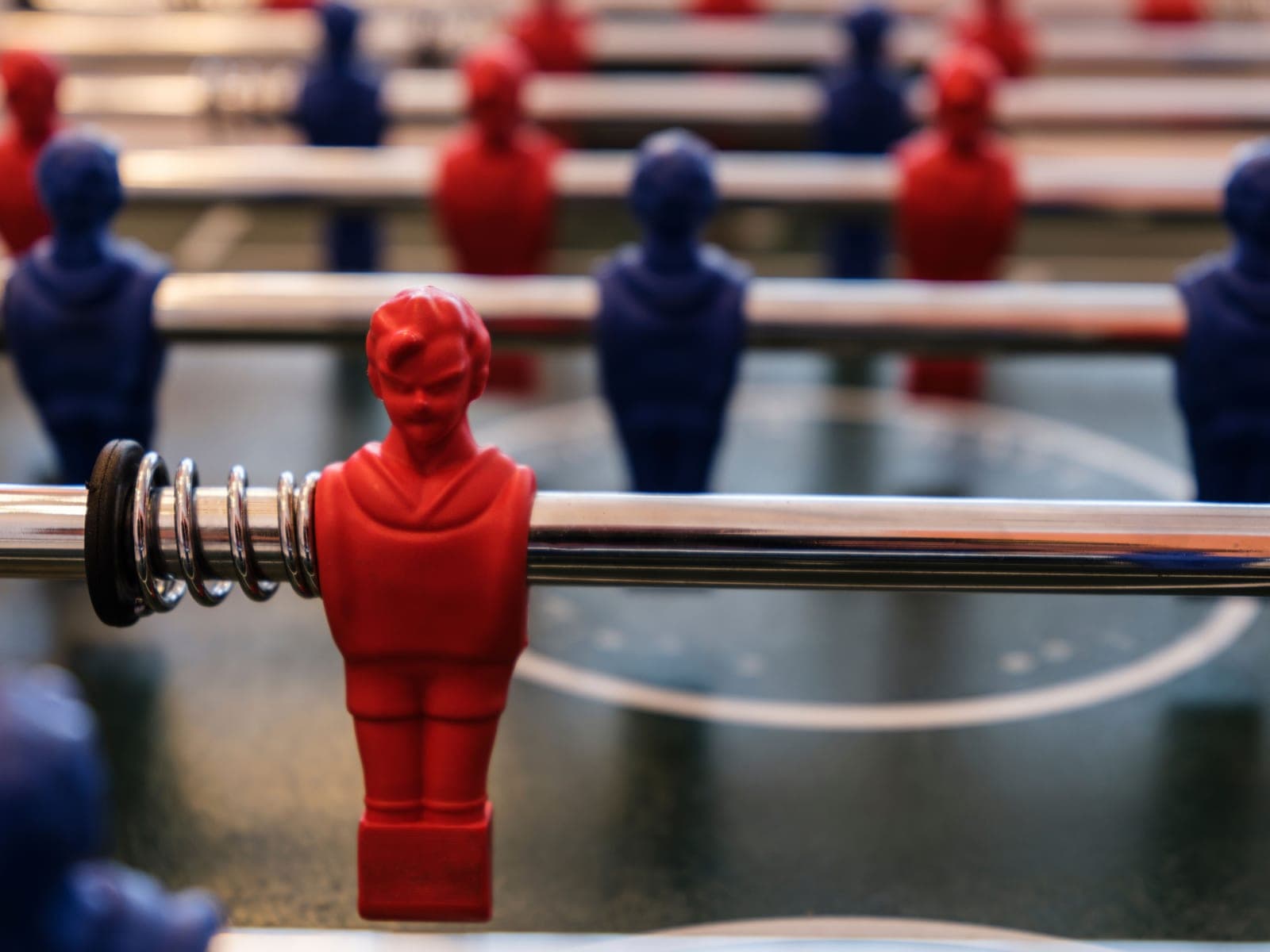 Tornado Tournament 3000 Foosball Table | The adult table that ends the discussion | 355 lb, ITSF-certified | |
| 2 | Garlando G-500 Foosball Table | An adult table close to a wall | Telescoping rods | |
| 3 | 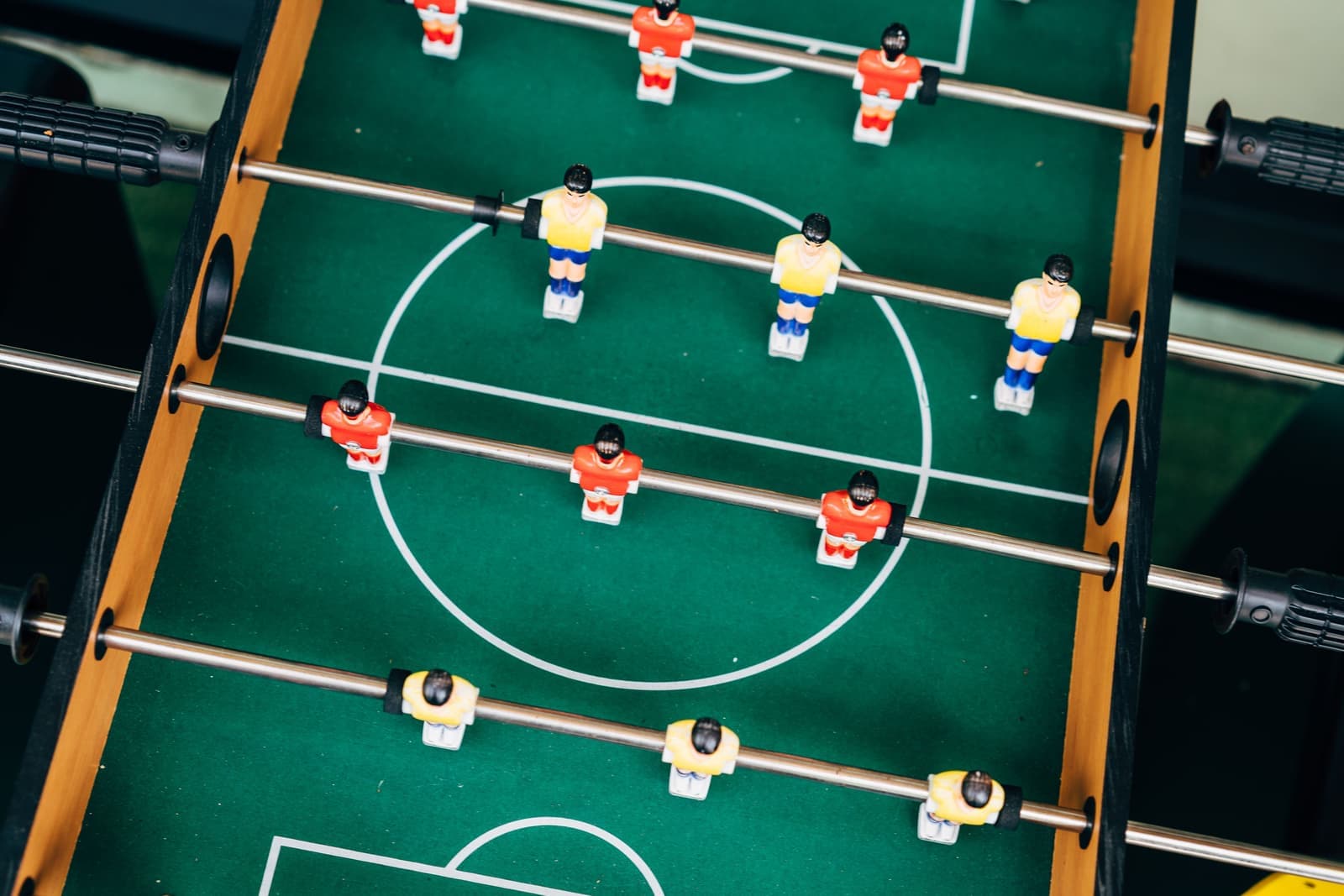 KICK Legend 55 in Foosball Table | A regulation game without the commercial weight | 55 in, wood frame | |
| 4 | Atomic Azure LED Light-Up Foosball Table | An adult room that is also a bar | 116 lb, LED, scoring |
The picks
The commercial table, the telescoping-rod table for a wall, the regulation wood frame in the middle, and the lit social table with its weight stated honestly.
#1 · The adult table that ends the discussion
Tornado Tournament 3000 Foosball Table
The commercial, ITSF-certified table used on the Tornado National Tour. Listed at 355 lb — it is furniture you do not move again.
The commercial, ITSF-certified table used on the Tornado National Tour, listed at 355 lb. Weight is the spec that matters here and 355 lb is the whole answer: a cabinet that heavy does not move, does not rock when two adults pull against each other, and does not transmit a shot into a wobble. It is furniture you do not move again, which is exactly the right property for a table that gets played hard by people who are not being careful.
- What works
- ITSF-certified geometry - the same table competitive play uses
- 355 lb cabinet is immovable under adult play
- Counterbalanced men and a serious ball, as competition requires
- What does not
- Through-rods need 12 to 15 inches of clear space beyond each long side, at rod height
- 355 lb is a one-way trip down a stairwell
#2 · An adult table close to a wall
Garlando G-500 Foosball Table
Telescoping rods with chromium plating. The telescoping design is what lets it sit closer to a wall than a through-rod table.
Telescoping rods with chromium plating, and the only sensible choice when the table has to live against a wall. On a through-rod table the rod slides out the far side as you pull, so the table needs clearance beyond its cabinet on both ends. Telescoping rods retract into themselves instead, which is how this table sits closer to a wall than a competition table ever will. The trade is a slightly different feel on the pull; most adults stop noticing inside a week.
- What works
- Telescoping rods remove the side clearance requirement
- Chromium plating holds up to constant adult handling
- A real wood-framed table rather than a flat-pack family unit
- What does not
- Telescoping rods feel marginally different from through-rods on the pull
- Not the cabinet mass of a competition table
#3 · A regulation game without the commercial weight
KICK Legend 55 in Foosball Table
A regulation-size wood-frame table that ships with both uniformed and counterbalanced men and a one- or three-rod goalie option.
A regulation-size wood-frame table that ships with both uniformed and counterbalanced men and a one- or three-rod goalie option. For an adult room that wants the proper game but cannot take 355 lb down the stairs, this is the middle path - full-size geometry, a real wood cabinet, and the goalie configuration choice that competitive and casual players argue about. Counterbalanced men in the box matter more than they sound: they stay where you leave them instead of flopping forward.
- What works
- Regulation size and a wood frame at a manageable weight
- Both men types and two goalie configurations included
- Easier to get into a basement than a commercial table
- What does not
- A lighter cabinet than a commercial table, so it can be shifted by hard play
- Through-rods, so it still needs 12 to 15 inches clear at each long side
#4 · An adult room that is also a bar
Atomic Azure LED Light-Up Foosball Table
In-rail LED lighting and electronic scoring, listed at 116 lb. Lighter than a competition table, and it plays like it.
In-rail LED lighting and electronic scoring, listed at 116 lb. Lighter than a competition table, and it plays like it - the cabinet will move if two people really lean into a shot. What it buys is atmosphere and automatic scoring, which in a room where foosball is one thing people do between drinks is a defensible priority. Just do not expect 116 lb to feel like 355 lb, because nothing does.
- What works
- In-rail LEDs and electronic scoring suit a social room
- 116 lb is movable by two people, so the room can be rearranged
- The lighting is genuinely useful on a dim playfield
- What does not
- 116 lb shifts under hard adult play
- Electronics are one more thing on a table that does not otherwise need power
Skip it if: the game matters more than the room does. A heavier cabinet with no lights plays better every single time.
Men, goalie configuration and the bits adults argue about
Two configuration details separate adult tables from family ones. The first is counterbalanced men: a counterbalanced player stays upright when you let go of the rod, instead of flopping forward over the ball. On a family table the men are not counterbalanced, so the ball gets trapped under a hanging player constantly and the game stops. Any table that ships counterbalanced men, or includes both sets, is telling you it expects real play.
The second is the goalie. A three-rod goalie - three men on the goal rod - is the American configuration and makes defending easier and the game longer. A one-rod goalie is the European configuration, harder to defend with and faster. Neither is correct; a table that gives you both lets the room decide. Adults who have played in bars usually expect three; adults who learned in Europe usually expect one.
Is foosball the right adult game for your room?
Foosball has two properties that make it unusually good for an adult games room: it is quick, so a game fits into the gap between two other things, and it is fully competitive within about ten minutes of learning. It also has one property worth knowing about in advance - it is loud. A hard shot into the back of a wooden goal is a bang, and it carries through a floor far better than an air hockey blower does.
If noise through the ceiling is a constraint, or if the room cannot give up the rod clearance, read foosball against air hockey before deciding, and whether a foosball table is worth it for the honest case against.
What we checked, and what we did not
Cabinet weights, rod types, men configurations and certification claims are each manufacturer's own listed specifications. Table and rod standards come from the governing-body reference cited below. The clearance figures follow from rod geometry. We have not played these tables side by side, we publish no scores or ratings, and nothing here should be read as test data.