Guide
Dartboard Surround Size
A standard surround is about 27 to 28 inches across, which gives you roughly 5 inches of protection past the edge of a 17.75-inch board. That is the whole number, and whether it is enough depends on how you miss.
How these picks were made: from published manufacturer specifications, governing-body standards and the room arithmetic - not from first-hand use. We have not played on these tables. Read the method.
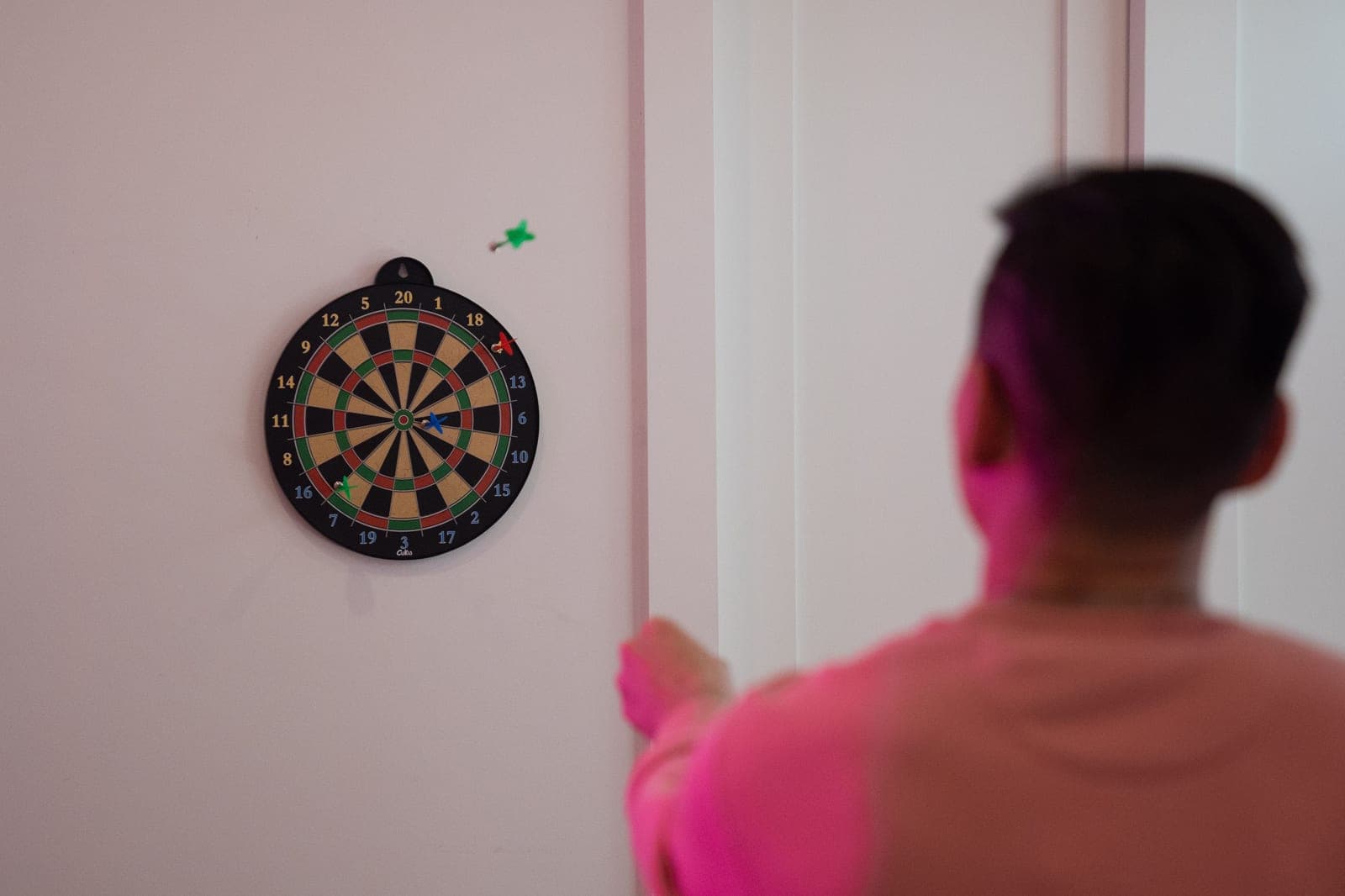
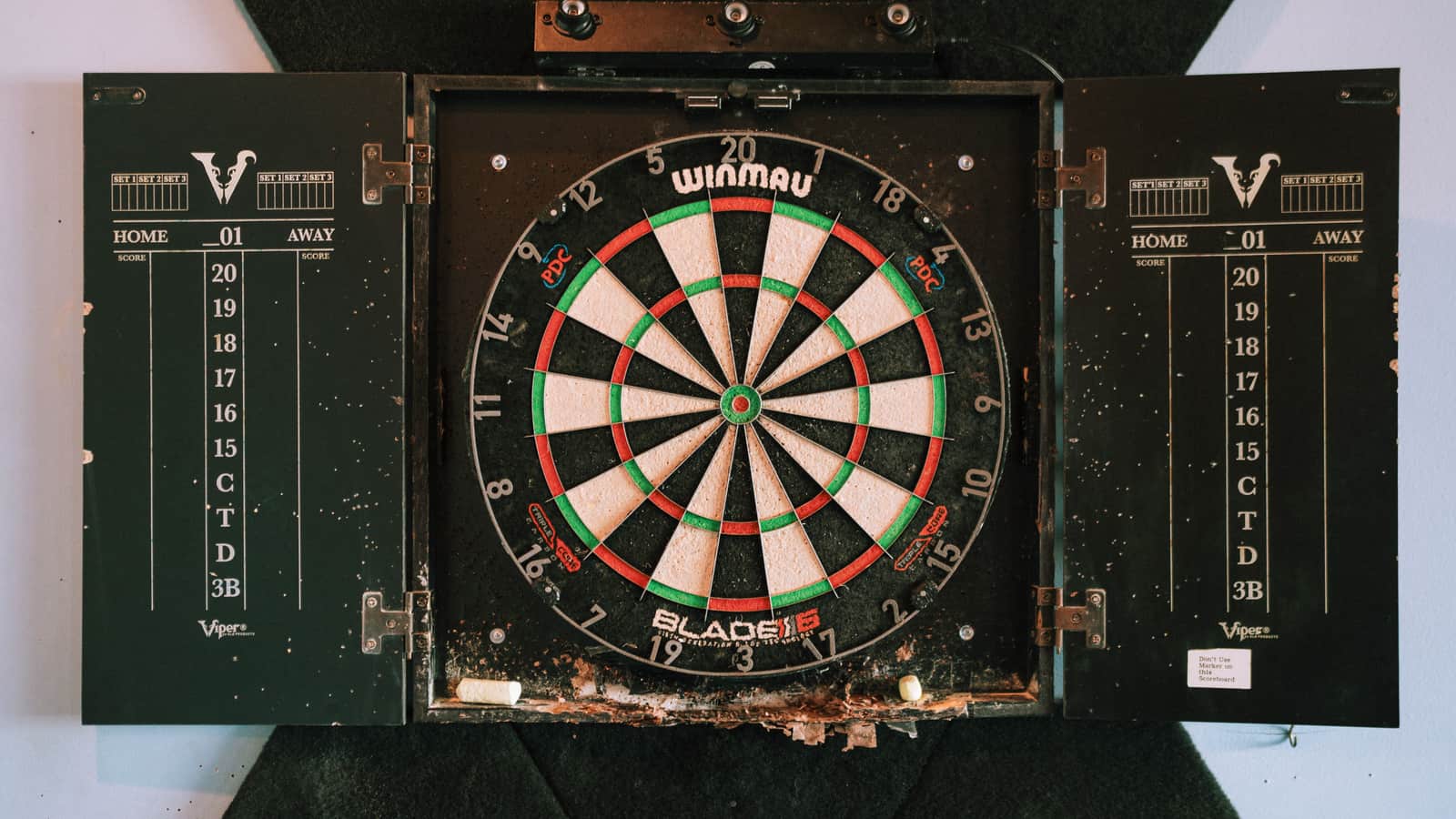
A standard dartboard surround measures roughly 27 to 28 inches across and fits over an 18-inch board, so it adds about 5 inches of protected surface all the way around. A regulation bristle board is 17.75 inches in diameter, which is the number the surround has to match on the inside. If your misses land further out than about 5 inches from the board edge, a ring will not save your wall and a full rectangular backboard - typically around 29 by 31 inches - is the right purchase instead.
The measurements, with the board included
There are only a handful of numbers here and they are worth having in one place, because listings quote them inconsistently - sometimes as outside diameter, sometimes as nominal board size, sometimes as a hole diameter.
| Item | Typical size | Protection past board edge |
|---|---|---|
| Regulation bristle board | 17.75 in diameter | n/a |
| Surround ring | 27-28 in outside diameter | ~5 in all round |
| Oversized surround ring | 29-31 in outside diameter | ~6-7 in all round |
| Rectangular backboard | ~29 x 31 in | ~6 in sides, more above and below |
| Cabinet, doors closed | ~22-26 in wide | Doors only, not a miss catcher |
Note what the last row is saying. A cabinet is not wall protection in the way a surround is. The doors protect the board when nobody is throwing, and the carcass covers the wall directly behind the board - but the area a stray dart actually hits is the wall beside the board, which an open cabinet door does not cover and may even hold open into the line of fire. The cabinet dimensions page has the carcass and door-swing figures.
Does the surround need to match the board brand?
No. Surrounds are sized to the regulation board diameter, not to a brand, so any surround listed as fitting a standard 18-inch board will fit any regulation bristle board. The one thing to check is depth rather than diameter: a surround sits over the board's outer wire ring, and a board with a thicker rolled edge or a staple-free bullseye construction can sit slightly differently in the recess. In practice every modern bristle board is close enough.
Electronic boards are the exception. A soft-tip electronic board is typically larger overall than 17.75 inches because the scoring segments and the housing extend beyond the playing area, and most come with their own integrated catch ring. A standard bristle-board surround will not fit one, and generally does not need to - soft tips do not hole drywall anyway.
What to buy, by how you miss
A ring for near misses, a backboard for wide ones, and a mat for the half of the damage that happens on the floor.
#1 · The standard ring
Winmau Pro-Line Dartboard Surround
A foam ring that catches the darts that miss the board. Cheaper than filling holes, and it fits over most bristle boards.
A foam ring that catches the darts that miss the board. Cheaper than filling holes, and it fits over most bristle boards. The coverage is the thing to understand before you buy: a ring of this type adds roughly 5 inches of protected surface all the way around, which catches the near miss that clips the wire and drops out, and does nothing at all for the dart that sails 10 inches wide of the 20.
- What works
- Fits over the outer ring of a standard 17.75-inch bristle board
- Foam closes around the holes, so it stays looking intact
- Removable, so the board can still be rotated for even wear
- What does not
- Roughly 5 inches of coverage is a near-miss solution only
- Does not give you a flat mounting surface on a rough wall
#2 · A wide or high miss
Viper Wall Defender Dartboard Backboard
A full backboard rather than a ring. Buy this one if your throws spray wide rather than low.
A full backboard rather than a ring. Buy this one if your throws spray wide rather than low. A backboard is the answer when 5 inches is not enough, because a rectangular panel is simply bigger in the directions a beginner actually misses - wide and high. It also solves a problem a ring cannot touch: on bare studs, OSB or block, a backboard gives you a flat finished plane to mount the board on.
- What works
- Covers a far wider miss than a ring in every direction
- Provides a flat mounting surface on a rough or uneven wall
- Takes the damage instead of the wall, and is itself replaceable
- What does not
- A much bigger wall footprint to find room for
- Does nothing for a dart that misses the whole assembly
#3 · The misses that go down
Viper Dart Throw Line Mat
A mat with the oche marked at the regulation distance. Also the cheapest way to stop a dropped dart chipping a tile floor.
A mat with the oche marked at the regulation distance. Also the cheapest way to stop a dropped dart chipping a tile floor. Worth pairing with any surround, because the surround addresses the wall and the floor is where the other half of the damage happens - a dart that bounces out of the wires lands point-first on whatever is below, and on tile or sealed concrete that chips the point. A chipped point bounces out more, which starts the cycle again.
- What works
- Oche marked at the regulation distance, so the setup is right
- Protects the floor from bounce-outs and drops
- Protects the dart points, which is the less obvious half of it
- What does not
- Does nothing for the wall
- A mat on carpet can creep under foot traffic
Diagnose the miss before you buy the size
The reason a 5-inch ring is adequate for some people and useless for others is that misses are not random - they cluster, and the cluster is personal. Throwers who have the distance right but release inconsistently produce a tight spray that clips the wires and drops: a ring catches almost all of it. Beginners, and anybody throwing after a drink, produce wide misses that go out to the sides and high: a ring catches none of it.
The cheap diagnostic is to tape a sheet of cardboard the size of a backboard to the wall for a week, mark where everything lands, and then measure the outliers. The spread you get is the size of protection you need. People who do this usually discover their misses are wider and higher than they assumed, because a dart that lands badly and falls out leaves no evidence. The surrounds and backboards roundup covers the product choices for each pattern.
What a surround does for the board, not the wall
There is a second, less-discussed benefit. A dart that hits the outer wire of a bare board often deflects off the metal and comes back at the thrower. With a foam surround fitted, the same dart hits foam instead and either sticks or drops straight down. That changes bounce-outs from a projectile problem into a floor problem, which is both safer and quieter - and it is why a surround plus a mat is a more sensible pairing than either on its own.
A surround also protects the board's own outer ring from the repeated edge strikes that eventually loosen the number ring. On a board you intend to rotate for years, that is a real contribution to its life. The wall protection page ranks every option by coverage, including the ones that do not work.
Sources and method
The board diameter and the 5 ft 8 in bullseye height are the published World Darts Federation regulation figures, cited below. Surround, backboard and cabinet dimensions are typical published product sizes and vary between makers - check the specific listing before ordering. The miss-pattern reasoning is practical observation about geometry, not test data; we have not thrown at these products and publish no ratings or scores.