Guide
Dart Board Cabinet Dimensions
A cabinet is about 22 to 26 inches wide closed, around 4 to 5 inches deep, and roughly double its width with the doors open. The door swing is the number that catches people out.
How these picks were made: from published manufacturer specifications, governing-body standards and the room arithmetic - not from first-hand use. We have not played on these tables. Read the method.
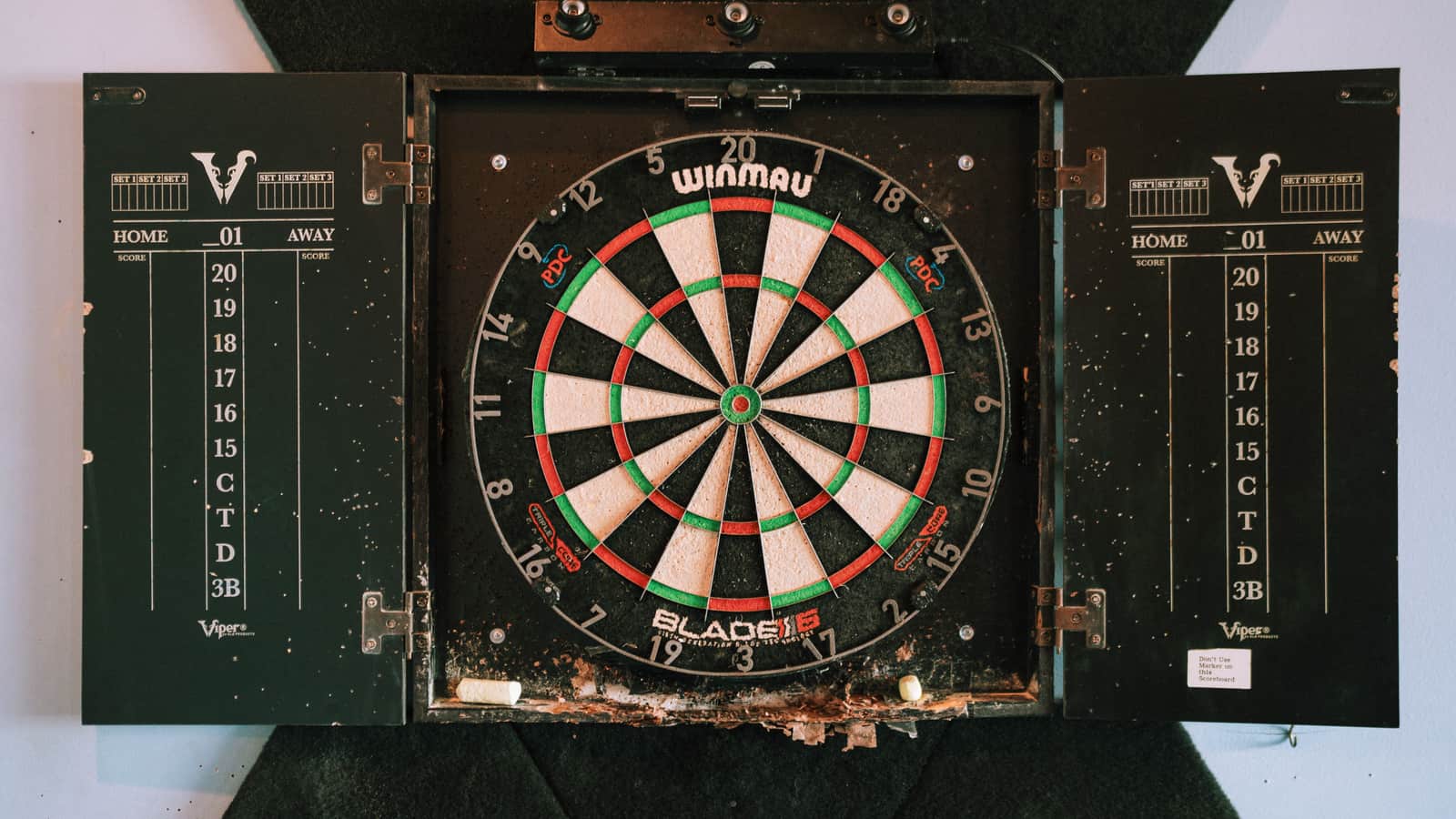
A dartboard cabinet is typically 22 to 26 inches wide and 24 to 28 inches tall with the doors closed, about 4 to 5 inches deep, and roughly 44 to 52 inches wide with both doors open. The mounting height is set by the board, not the cabinet: the bullseye must sit 5 ft 8 in (1.73 m) from the floor, so you hang the cabinet wherever puts the board's center at that height - usually with the top of the carcass somewhere around 7 feet.
Every measurement, in one table
Cabinet dimensions vary between makers, so treat these as the ranges to plan around and confirm against the specific listing. The two figures that are not negotiable are the board diameter and the bullseye height, because those are regulation.
| Measurement | Typical figure | Why it matters |
|---|---|---|
| Width, doors closed | 22-26 in | The wall space it occupies between games |
| Width, doors open | 44-52 in | The space it needs during play - the one people forget |
| Height of carcass | 24-28 in | Clearance above the board line |
| Height with integrated light | 28-32 in | Extra height sits above the board |
| Depth | 4-5 in | Must clear the board plus a dart standing in it |
| Board diameter (regulation) | 17.75 in | The recess has to take it |
| Bullseye height (regulation) | 5 ft 8 in | Sets where the cabinet hangs |
| Weight, solid wood | 25-40 lb plus board | Decides the fixing |
Door swing is the dimension that catches people out
Closed, a cabinet is a tidy two-foot square on the wall. Open, it is four feet wide, and it is open every time anybody plays. The common mistake is to site a cabinet in a two-foot gap between a doorway and a window, or next to a corner, and discover that one door cannot open past 45 degrees. A half-open door is in the flight path of any dart thrown from the left or right of center, which is most of them.
Measure the open width and treat it as the real footprint. If the wall genuinely cannot take 44 inches, the answer is not a smaller cabinet - cabinets do not get much narrower than the board - it is a surround or a backboard instead, which has no doors at all. The surround size page has those dimensions for comparison.
Three cabinets, by what they add
The plain wood carcass, the one with scoring inside the doors, and the one with the light built into the top.
#1 · The straightforward wall cabinet
Viper Metropolitan Dartboard Cabinet
A solid-wood cabinet that closes over the board. The doors are the wall protection, and they only work as far as they reach.
A solid-wood cabinet that closes over the board. The doors are the wall protection, and they only work as far as they reach. Dimensionally this is the type most people picture: a carcass a little wider than the board, deep enough to clear the board and a dart in it, and two doors that swing out to roughly double the installed width. Solid wood is relevant to the dimensions conversation because it is heavier than MDF, which changes the fixing requirement.
- What works
- Carcass sized closely to the board, so the wall footprint is modest closed
- Solid wood carries the repeated impact of darts without denting through
- Closed, it reads as furniture rather than as a dartboard
- What does not
- Open doors roughly double the width - measure both states
- Heavier than MDF, so it wants a stud rather than an anchor
#2 · Scoring surfaces inside the doors
Winmau Xtreme 2 Dartboard Cabinet
A cabinet with built-in scoring surfaces inside the doors. Pairs with a Blade board as a single wall install.
A cabinet with built-in scoring surfaces inside the doors. Pairs with a Blade board as a single wall install. The scoring surfaces change the geometry in a useful way: because the doors are the scoreboard, you want them open and visible during play, which means the open width is the width you have to plan for permanently rather than only during a game.
- What works
- Scoring inside the doors removes the separate chalkboard from the wall
- Designed around a standard bristle board, so the recess fits
- One wall install instead of three separate items
- What does not
- The doors stay open during play, so plan for the open width always
- Scoring surfaces need to be lit as well as the board does
#3 · When the room has no light on the board
Viper Metropolitan Dartboard Cabinet with LED Light
A cabinet with integrated lighting, which solves the real problem: a ceiling light behind you puts your own shadow on the board.
A cabinet with integrated lighting, which solves the real problem: a ceiling light behind you puts your own shadow on the board. Dimensionally the thing to know is that the lighting lives in the top of the carcass, so this style is taller than a plain cabinet for the same board - and the extra height is above the board, where it has to clear whatever is above your mounting line.
- What works
- Integrated light puts illumination in front of the board, where it belongs
- No separate fixture to find a mounting point for
- Removes the thrower's shadow, which is the usual scoring complaint
- What does not
- Taller carcass than a plain cabinet - check headroom above the board
- Needs power at the mounting height
Depth, and why 4 inches is the figure
A bristle board is roughly 1.5 inches thick. A steel-tip dart standing in the board sticks out about 5 to 6 inches from its face. A cabinet does not have to be deep enough to close over a dart left in the board - you take the darts out - so the depth that matters is board thickness plus a little clearance for the mounting bracket behind it, which lands at 4 to 5 inches.
What that means practically is that a cabinet projects about 5 inches into the room at chest-to-head height. In a narrow room or a hallway, that is a real obstruction for anybody walking past - and the top edge of a cabinet at 7 feet is above head height, but the bottom edge at around 4 feet 6 inches is not. Site it where nobody walks within arm's reach of the wall.
Fixings: the weight is more than the cabinet
A solid-wood cabinet is typically 25 to 40 lb empty, and a bristle board adds a further 10 to 12 lb. So the hanging load is often 40 to 50 lb, applied at the top of a panel that then gets struck repeatedly by flying metal. A single drywall anchor is not adequate for that, and the failure mode is slow: the anchor works loose over months, the cabinet tilts slightly, and the board's height drifts out of regulation before it eventually comes off the wall.
Hit a stud. Studs are normally at 16-inch centers, and a 22 to 26-inch cabinet is wide enough to reach two of them, which is the ideal fixing. If the cabinet's mounting points do not line up with studs, fix a horizontal timber batten across two studs first and hang the cabinet on that. On concrete block, use sleeve anchors rather than plastic plugs. The wall protection page covers the mounting question for every option.
Throw-line clearance, measured from the cabinet face
One more dimension gets forgotten. The regulation throw distance for steel tip is 7 ft 9.25 in, measured horizontally from the face of the board - not from the wall. A cabinet moves the board face about 2 inches further into the room than a bare board would be, which moves the oche by the same 2 inches. On its own that is trivial, but it is the difference between a mat that reaches and one that does not when the room is tight.
The diagonal check is the real test: from the bullseye to the throw line should be 9 ft 7.375 in for steel tip. Measure that with a tape and you catch every accumulated error at once. The height and distance page has both formats' figures and the diagonal for each.
Sources and method
The bullseye height, throw distances, diagonal check and board diameter are the published World Darts Federation regulation figures cited below. Cabinet widths, heights, depths and weights are typical published product dimensions and vary between makers - confirm against the listing before drilling. Stud spacing is standard residential framing practice. We have not installed these cabinets, we publish no ratings or scores, and nothing here is presented as test data.