Picks
The Best Dart Boards for Kids
One decision makes a dart board safe for a child: soft tip, not steel. Everything after that is scoring features and how far up the wall it hangs.
How these picks were made: from published manufacturer specifications, governing-body standards and the room arithmetic - not from first-hand use. We have not played on these tables. Read the method.
Buy a soft-tip electronic board and hang it lower than regulation. For a child of about seven, the Viper 787 is the board to start with, because the tips do not mark drywall and the machine does the scoring. From ten upward, the Gran Board 3s is quieter and the app gives them a reason to practice. Steel-tip bristle boards are excellent boards and they are not children's boards, for a reason that has nothing to do with skill.
Soft tip is the whole safety decision
A steel-tip dart is a 22-gram metal spike thrown at a wall. It is safe in a room of adults who respect it, which is why leagues use it. In a room where a six-year-old might walk in front of the board, or where a dart that bounces out lands point-up on carpet, the calculation is different. Soft-tip darts have a plastic point that flexes - they still hurt, they still need the same throwing-line discipline, and they do not embed in a leg, a door or a baseboard.
The second reason is the wall. A missed steel-tip dart leaves a hole that needs filling. A missed soft-tip dart leaves a mark you can rub out. In a finished basement or a family room, that difference decides whether the board stays on the wall. The wall protection page covers the surrounds and backboards that handle the rest.
Hang it lower, and the game still works
The regulation height is 5 ft 8 in from the floor to the center of the bullseye, with the throwing line 7 ft 9.25 in away for steel tip and 8 ft for soft tip. Those figures come from the governing bodies and they assume an adult. A child throwing at a bullseye above their own head gets a lofted, inaccurate throw and learns a technique they will have to unlearn.
There is no official junior height, so the honest approach is proportional: set the bullseye at the child's eye level and shorten the throw line to match. Mark the adult oche as well, because the board should still be correct for the grown-ups.
| Thrower | Bullseye height | Throw line distance | Basis |
|---|---|---|---|
| Adult, steel tip | 5 ft 8 in | 7 ft 9.25 in | WDF regulation |
| Adult, soft tip | 5 ft 8 in | 8 ft | Soft-tip standard |
| Ages 6-8 | About 4 ft 0 in | About 5 ft 6 in | Proportional to eye level |
| Ages 9-11 | About 4 ft 6 in | About 6 ft 6 in | Proportional to eye level |
| Ages 12-14 | About 5 ft 2 in | About 7 ft 3 in | Proportional to eye level |
Quick picks
| # | Product | Best for | Board type | Price |
|---|---|---|---|---|
| 1 | 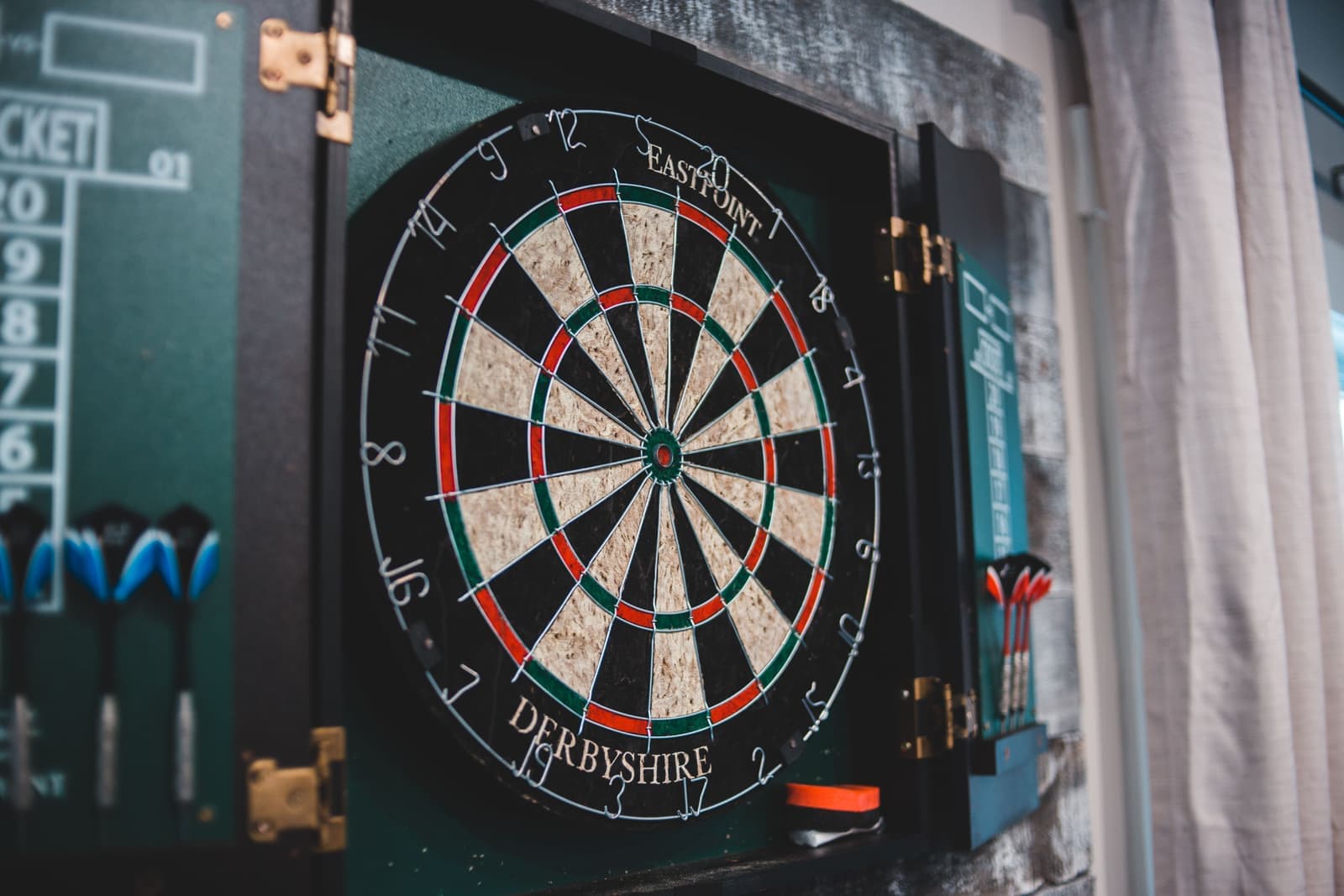 Viper 787 Electronic Soft-Tip Dartboard | The first board, ages 7 and up | Soft tip, electronic | |
| 2 | Gran Board 3s Bluetooth Electronic Dartboard | Ages 10 and up, and quiet houses | Bluetooth, app scoring | |
| 3 | Arachnid Cricket Pro Electronic Dartboard | A family board that grows up with them | Soft tip, LED display | |
| 4 |  Viper Metropolitan Dartboard Cabinet with LED Light | A finished room where the wall matters | Cabinet with LED light |
The picks
Youngest-first, with the lit cabinet last because it is a wall decision rather than an age one.
#1 · The first board, ages 7 and up
Viper 787 Electronic Soft-Tip Dartboard
An entry electronic board with the usual pile of game modes. Soft-tip darts mean no holes in the drywall behind it.
An entry electronic board with the usual pile of game modes. Soft-tip darts mean no holes in the drywall behind it, and that single fact is why this is the right first board rather than any bristle board at any price. The automatic scoring is the second reason: a seven-year-old who cannot do the subtraction can still play 301.
- What works
- Soft tips do not mark drywall, trim or a door
- Scores for them, so the maths is not a barrier to playing
- Light enough to hang on a single wall anchor
- What does not
- Segment holes wear and eventually mis-score
- Plastic board face feels nothing like sisal if they later move to steel tip
#2 · Ages 10 and up, and quiet houses
Gran Board 3s Bluetooth Electronic Dartboard
Bluetooth scoring to a phone app with online play. Also the quietest electronic board most people have thrown at.
Bluetooth scoring to a phone app with online play, and the quietest electronic board most people have thrown at. The noise point is not a small one with children: a hard plastic board on a hollow wall is a loud, repetitive thud, and this is the format that reduces it. The app also keeps a history, which turns practice into something a ten-year-old will do unprompted.
- What works
- Noticeably quieter than a standard plastic electronic board
- App history and online play give an older child a reason to keep at it
- Scoring is on a screen they already stare at
- What does not
- Needs a phone or tablet nearby to score at all
- More board than a seven-year-old needs
#3 · A family board that grows up with them
Arachnid Cricket Pro Electronic Dartboard
Soft-tip electronic scoring with a long game list and an LED display. Scoring is the feature; the throw is quieter than steel tip.
Soft-tip electronic scoring with a long game list and an LED display. Buy it when the board has to satisfy a nine-year-old and the adults in the house on the same evening - the game list is deep enough for adult cricket and the scoring is automatic enough for a child. It is the one board here that does not get replaced in three years.
- What works
- Deep game list covers a child's 301 and an adult's cricket
- Standalone LED display - no phone required
- Built for repeated family use rather than a single player
- What does not
- Louder than the Bluetooth board
- Bigger wall footprint, so measure the space before hanging
#4 · A finished room where the wall matters
Viper Metropolitan Dartboard Cabinet with LED Light
A cabinet with integrated lighting, which solves the real problem: a ceiling light behind you puts your own shadow on the board.
A cabinet with integrated lighting, which solves the real problem: a ceiling light behind the thrower puts their own shadow on the board. With children there is a second benefit - the doors close over the board, so it is not an invitation at head height every time someone walks past with a dart in their hand.
- What works
- Doors close the board off between sessions
- Integrated light removes the shadow a ceiling fixture casts
- The doors are the first line of wall protection
- What does not
- Protects only as far as the doors reach - wide throws still find the wall
- Needs power at the mounting height
Skip it if: you are mounting in a garage or unfinished basement. There, a foam surround costs less and covers a wider miss.
What the throwing lane needs to be clear of
A dart board needs very little width and a surprising amount of length: about 5 feet of width centered on the board, and the throw distance plus roughly 2 feet behind the line for the thrower's stance and backswing. With children, add a hard rule that the lane is a lane - nobody stands in it, nobody crosses it, and nothing that someone might want mid-game lives behind the board.
The common domestic mistake is hanging the board on the wall at the end of a walkway, so the throwing lane is also the route to the laundry. The small-room throw-line page works through the layouts that avoid that.
Magnetic boards, and why they are not here
Magnetic dart boards exist, they are genuinely safe for a four-year-old, and they are a different product: the darts do not stick reliably, the scoring areas are approximate, and the game teaches nothing that transfers. If you have a preschooler, a magnetic board is a reasonable toy. If you have a child of seven who wants to play darts, a soft-tip electronic board is the real version of the same thing and it will still be in use in five years.
What we checked, and what we did not
The adult heights and distances are the published governing-body figures, cited below. The junior rows are explicitly our own proportional arithmetic from child eye level and are labeled as such, because no governing body publishes a junior standard. Board features are the manufacturers' listed specifications. We have not thrown at these boards and publish no ratings or scores.