Compare
58-Inch vs Short Pool Cues
A 48-inch cue buys back ten inches of required clearance per side. Here is what those ten inches cost you.
How these picks were made: from published manufacturer specifications, governing-body standards and the room arithmetic - not from first-hand use. We have not played on these tables. Read the method.

The arithmetic
| Cue | Clearance needed | Saved vs 58 in | Realistic cost |
|---|---|---|---|
| 58 in | 64 in | - | None |
| 52 in | 58 in | 6 in | Slight leverage loss on long shots |
| 48 in | 54 in | 10 in | Noticeable power and spin reduction |
| 42 in | 48 in | 16 in | Significant - a specialist cue |
| 36 in (jab) | 42 in | 22 in | Control only; emergency shots |
On a 7-foot table, using 48-inch cues on all four sides shrinks the room requirement from 17 ft 2 in by 13 ft 11 in down to 15 ft 4 in by 12 ft 1 in. That is nearly two feet in each direction, which is often the difference between a table that works and one that does not.
What a short cue actually costs you
- Power. A shorter cue is a shorter lever with a shorter stroke, so a break or a long-distance shot has less behind it.
- Spin control. Applying side spin accurately needs a longer, more stable stroke. Short cues make it harder to be precise about it.
- Consistency. A different cue in your hand is a different feel. Switching cues mid-game between rails introduces its own small error.
- Bridge length. A shorter cue is bridged closer to the tip, which some players find helps accuracy on short shots - the one genuine advantage.
Quick picks
| # | Product | Best for | Key spec | Price |
|---|---|---|---|---|
| 1 | Players Short Pool Cue (48 in / 52 in) | The tight side | 48 in / 52 in | |
| 2 |  Players C-960 Pool Cue | The sides with room | 58 in | |
| 3 | 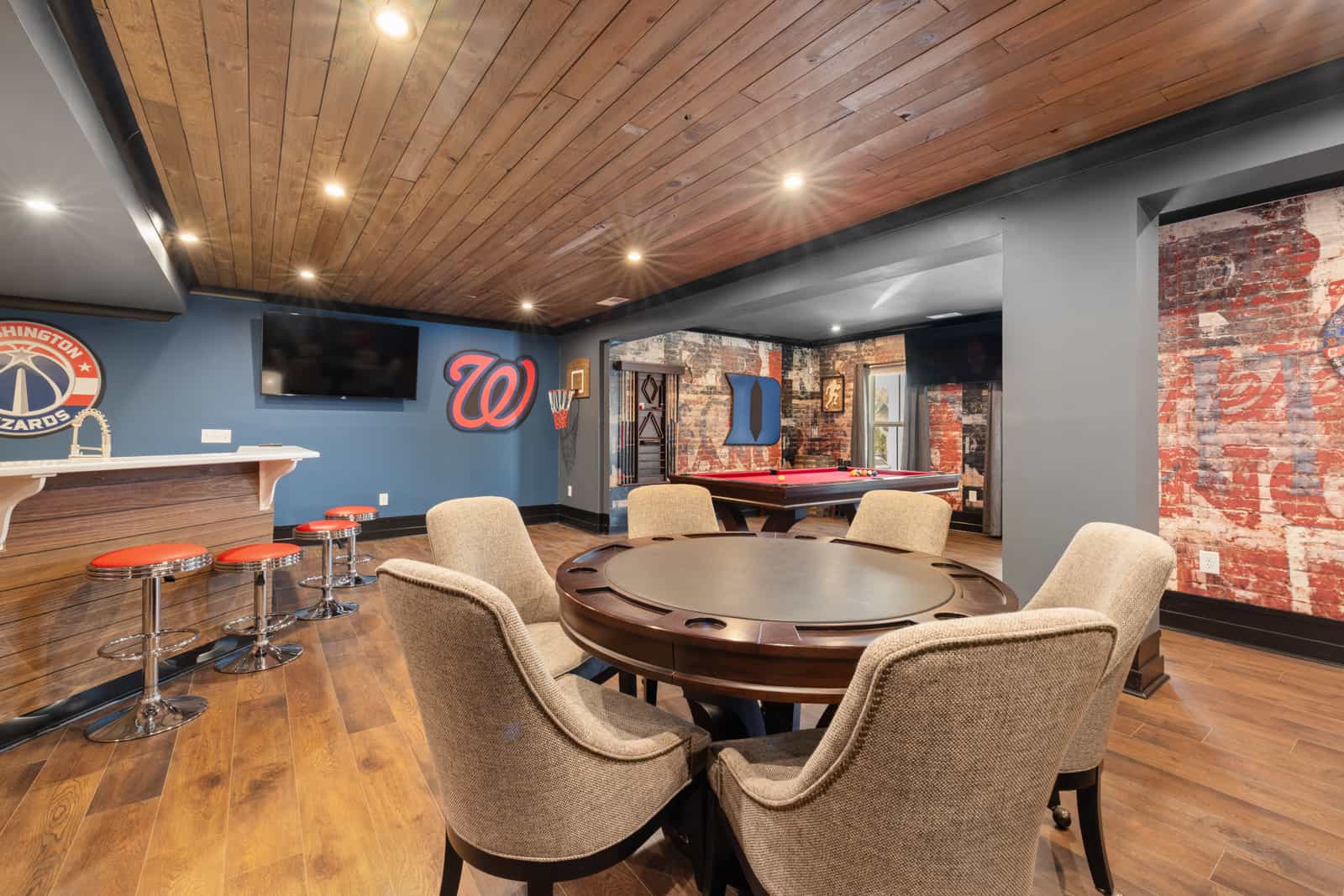 Mizerak Dynasty Space Saver 6.5 ft Billiard Table | Fixing it at the table instead | 6.5 ft |
What to put on the rack
#1 · The tight side
Players Short Pool Cue (48 in / 52 in)
A short cue for the side of the table that lost its clearance to a wall. Two of these fix most tight-room tables.
Two of these fix most small-room tables, and together they cost less than a cover.
- What works
- 48 in buys back 10 in of clearance per side
- 52 in buys 6 in with almost no feel penalty
- What does not
- Less leverage on a long shot
#2 · The sides with room
Players C-960 Pool Cue
A maple two-piece with an Irish linen wrap at a price that makes buying two sensible. The usual first serious cue.
Full length everywhere the room allows - there is no reason to use a short cue where a long one fits.
- What works
- Full stroke and leverage
- What does not
- Needs 64 in of clearance
#3 · Fixing it at the table instead
Mizerak Dynasty Space Saver 6.5 ft Billiard Table
A 6.5-foot table built specifically for rooms that fail the 7-foot clearance math. Short cues are still likely on at least one side.
If three or four sides are tight, the honest fix is a smaller table rather than four short cues.
- What works
- Removes the problem rather than working around it
- What does not
- Different cut angles to a full-size table
The alternatives to a short cue
- Move the table. If one side is tight and another has excess, shifting the table a foot can balance it. Obvious, frequently overlooked.
- Move the furniture. More rooms are fixed by relocating a sofa or a chest freezer than by any cue purchase.
- Re-hang a door. A door swinging into the room removes its own width permanently. Re-hanging it is an hour's work.
- Drop a table size. If three or four sides need short cues, the table is too big for the room. The size chart is here.
Jab cues and when they are legitimate
A 36-inch jab cue is for a ball frozen against an obstruction - a wall, a post, a radiator - where even a 48-inch cue will not fit. It is a specialist tool and not a cue you play with generally. If you reach for it regularly, the table is in the wrong place.
Method
Clearance figures are arithmetic from cue length plus a 6-inch stroke allowance, the same formula used across this site. The described costs follow from cue length and leverage rather than from play testing we conducted.