Picks
The Best Foosball Tables for Kids
A kids' foosball table is decided by two numbers nobody prints on the box: how high the rods sit, and how little the table weighs.
How these picks were made: from published manufacturer specifications, governing-body standards and the room arithmetic - not from first-hand use. We have not played on these tables. Read the method.
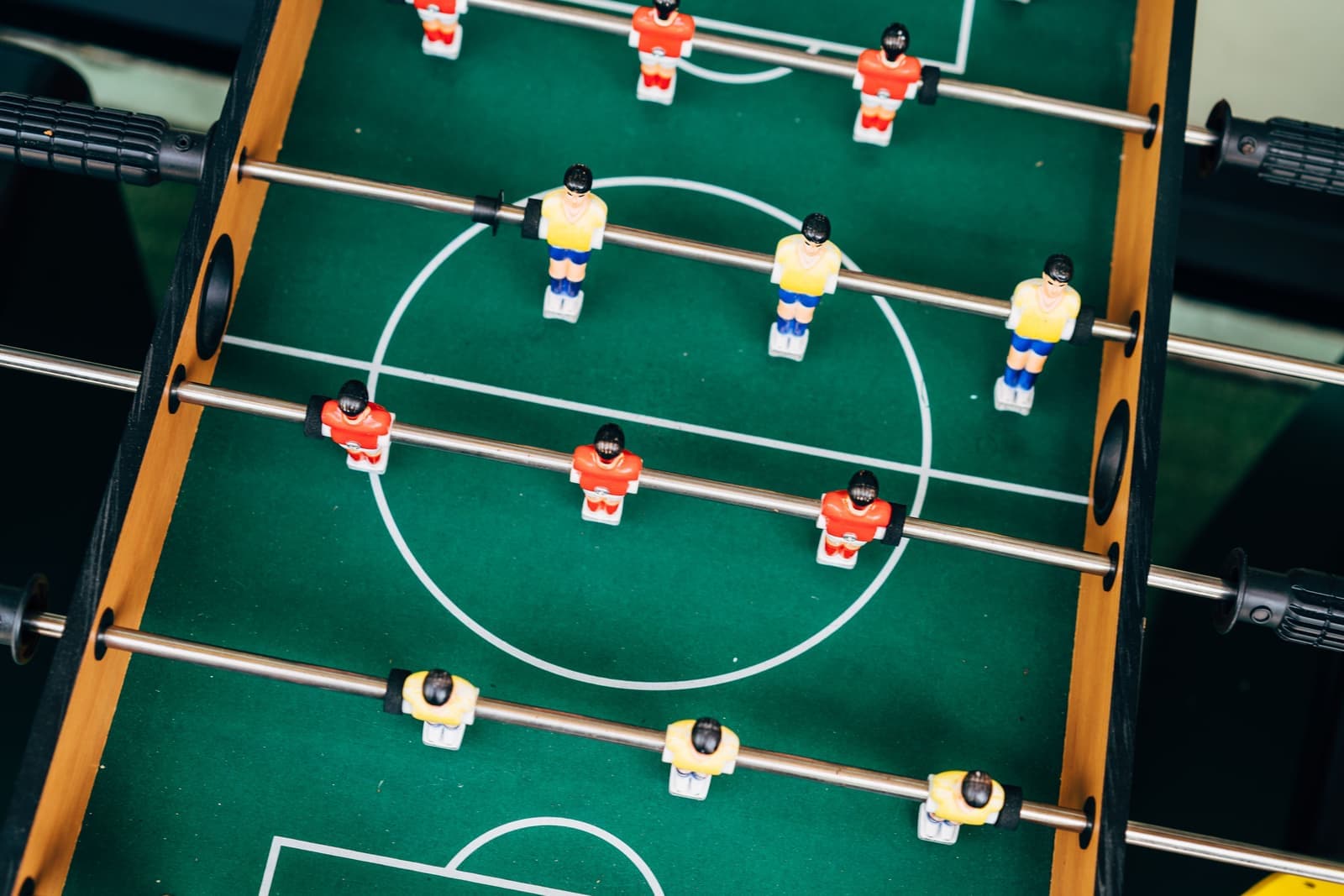
If the child is under about eight, buy the Sport Squad FX40 tabletop and set it on a surface that puts the rods at their chest height. If they are eight to twelve, the ESPN table at 56 by 29 inches and 92 pounds is the first full-size table that makes sense, because a 92-pound cabinet is forgiving of the way children use furniture. Everything else on this page is a variation on those two answers.
Why play height decides this and graphics do not
A standard foosball table puts the rods at roughly 30 to 32 inches off the floor, the same height as a kitchen counter. An adult plays that with bent elbows and a straight back. A child of six is playing it with their arms above their shoulders, which means they cannot pull a rod back, cannot see the far end of the playfield, and lose every time. They do not conclude that the table is the wrong height. They conclude they are bad at foosball, and the table stops getting used.
The fix is not a shorter table, because almost nobody makes one. The fix is either a tabletop unit on a surface you choose, or waiting until the child's standing elbow height clears the rails. Measure your child's elbow height with their arms hanging loose: if it is below the rod height of the table you are considering, the table is too tall this year.
| Player | Format that fits | Rod height they get | What you give up |
|---|---|---|---|
| Ages 4-7 | Tabletop on a coffee table | About 20-24 in | Playfield size, rod travel |
| Ages 7-9 | Tabletop on a dining table | About 28-30 in | The dining table, while it is out |
| Ages 8-12 | Light full-size floor table | About 30-32 in standard | Cabinet rigidity |
| Ages 11+ | Wood-frame full-size table | About 30-32 in standard | Portability, and the lights |
| Mixed ages | Light full-size plus a step platform | Standard, plus 6 in of platform | Nothing, if the platform is stable |
Quick picks
| # | Product | Best for | Key spec | Price |
|---|---|---|---|---|
| 1 | Sport Squad FX40 Tabletop Foosball Table | Ages 5 to 8, or any room with no floor to give | 40 in tabletop | |
| 2 | 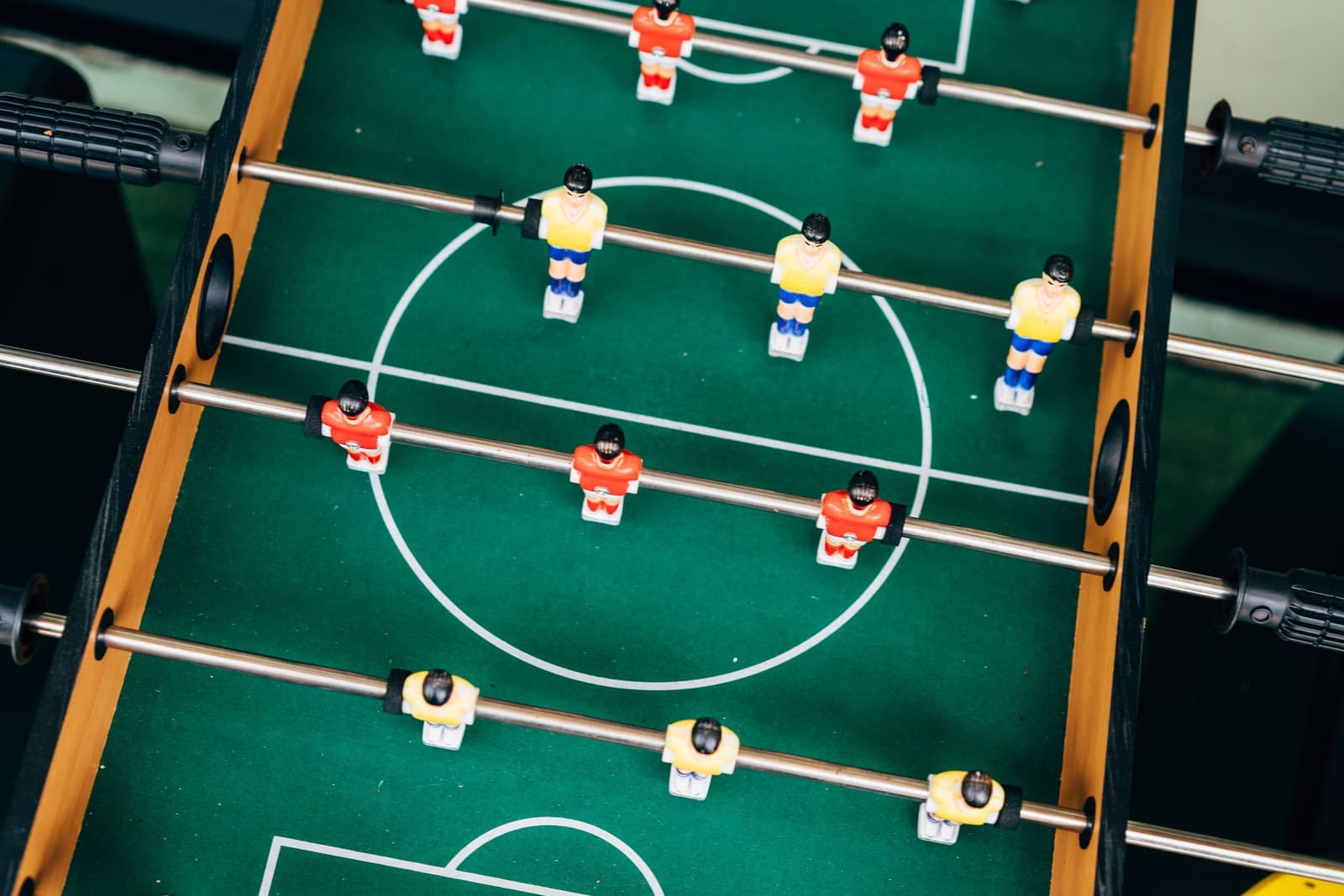 ESPN Foosball Table | Ages 8 to 12, as the first real table | 56 x 29 in, 92 lb | |
| 3 |  Atomic Azure LED Light-Up Foosball Table | Ages 10 and up, and evening play | 116 lb, in-rail LEDs | |
| 4 | KICK Legend 55 in Foosball Table | A table that outlasts childhood | 55 in, wood frame |
The picks
In order of the age they suit, youngest first.
#1 · Ages 5 to 8, or any room with no floor to give
Sport Squad FX40 Tabletop Foosball Table
A tabletop unit for rooms with no floor space left. Nobody confuses it with a real table; that is not what it is for.
For a child under about four feet tall, a floor-standing table is the wrong height and no amount of enthusiasm fixes it. A tabletop unit sits at whatever height you put it, so a dining table works for a ten-year-old and a coffee table works for a six-year-old. That adjustability is worth more than any feature on a bigger table.
- What works
- You choose the play height by choosing the surface it sits on
- Light enough that a child can carry it to the table themselves
- Stores on a shelf between games
- What does not
- Short rods and a small playfield - the game is quick rather than skillful
- Sits on a surface that then cannot be used for anything else
#2 · Ages 8 to 12, as the first real table
ESPN Foosball Table
Listed at 56 x 29 in and 92 lb on an MDF frame with a PVC laminate finish. A family table, priced like one.
Listed at 56 by 29 inches and 92 pounds on an MDF frame. That weight is the reason it belongs on this page rather than the main roundup: it is light enough for two adults to reposition after a scrape, and light enough that an 80-pound child leaning on a corner does not worry you. The trade is that the same lightness lets the cabinet flex on a hard shot.
- What works
- Full-size footprint at roughly a quarter of a competition table's weight
- Standard rail height suits a child from about eight upward
- PVC laminate wipes clean, which matters more than it sounds
- What does not
- MDF frame and laminate finish will show its life after a few years
- Light cabinet shifts slightly on an aggressive shot
#3 · Ages 10 and up, and evening play
Atomic Azure LED Light-Up Foosball Table
In-rail LED lighting and electronic scoring, listed at 116 lb. Lighter than a competition table, and it plays like it.
Listed at 116 pounds with in-rail LED lighting and electronic scoring. The lights are the reason children choose it and the scoring is the reason parents stop refereeing, and neither is a serious player's criterion - which is exactly the point on this page. It plays lighter than a competition table because it is lighter.
- What works
- Lit playfield makes a dim basement playable without ceiling work
- Electronic scoring removes the arguments
- Heavy enough to stay planted, light enough to move with two people
- What does not
- Needs a power outlet within reach of the table
- Ball speed and rod feel are a long way from a competition table
Skip it if: the table is going in a room with no outlet on the right wall. An extension cord across a foosball room is a trip hazard at exactly ankle height.
#4 · A table that outlasts childhood
KICK Legend 55 in Foosball Table
A regulation-size wood-frame table that ships with both uniformed and counterbalanced men and a one- or three-rod goalie option.
A regulation-size wood-frame table that ships with both uniformed and counterbalanced men and a one- or three-rod goalie option. Buy it when the child is about eleven and the table is meant to still be in the house when they leave it. The counterbalanced men are the detail that matters for a learner: the rods do not flop over when hands come off them.
- What works
- Wood frame rather than MDF, so it tolerates a decade of use
- Counterbalanced men hold position between shots
- Three-rod goalie option suits a smaller player's reach
- What does not
- Heavier to position, and it is not moving again afterward
- No lighting or electronic scoring
Telescoping rods are a children's safety feature
On a through-rod table, the rod passes all the way through the cabinet and sticks out the far side when you pull your handle back. That protruding steel sits at roughly head height for a standing four-year-old and at eye level for a toddler walking past. Telescoping rods retract into the cabinet instead, so nothing projects beyond the frame.
Serious players prefer through rods for a real reason: they are stiffer and they do not bind. On a family table with small children in the room the reasoning runs the other way, and it also means the table can sit closer to a wall. The full rod comparison covers the play difference in detail.
What a kids' table actually has to survive
- Leaning. Children put their whole weight on a rail to reach the far rods. An MDF cabinet with a laminate wrap tolerates this; a thin particleboard one does not.
- Spilled drink on the playfield. A sealed laminate surface wipes clean; a printed paper-laminate surface stains and lifts at the seams.
- Lost balls. Buy a bag of spares with the table. Every family table loses most of its balls in the first year, and a table with one ball left stops being played.
- Rod handle abuse. Rubber handles outlast plastic ones, and a split handle is the most common repair on a family table.
- Being moved. If the table has to come out of a room for anything, weight is the only spec that matters. Decide now whether it moves.
Clearance, with children in the room
A standard table is about 56 inches long and 29 inches wide. Allow at least 3 feet of clear floor at each end for the players and about 2 feet along each side, then add room for the people who are not playing, because with children there always are some. In practice a family foosball table wants a space around 11 by 8 feet to be comfortable rather than the 9 by 6 the bare arithmetic allows. The clearance page has the figures by table size.
What we checked, and what we did not
Dimensions and weights on this page are the manufacturers' published figures, and the rod-height band is the standard cabinet height range for home tables. The age guidance is arithmetic from child elbow height against that rod height, not a test result. We have not played on these tables and make no claim about rod feel or ball speed beyond what frame material and listed weight imply.