Guide
What Size Ping Pong Table Should I Get?
There is only one full size, and three honest ways to go smaller. Which one you need is decided by the floor you have, not by how seriously you play.
How these picks were made: from published manufacturer specifications, governing-body standards and the room arithmetic - not from first-hand use. We have not played on these tables. Read the method.

Get a full-size table - 9 feet by 5 feet, 30 inches high - if your room clears about 19 by 11 feet, or 17 by 9 at a push. If it does not, the honest choices are a midsize table, a compact table, or a conversion top laid over an existing pool table. There is exactly one regulation size, so the question is never which size plays best; it is how far down from regulation your room forces you, and which compromise you would rather live with.
The sizes, and what each gives up
| Format | Table size | Clear floor wanted | What you give up |
|---|---|---|---|
| Full size (regulation) | 9 x 5 ft, 30 in high | About 19 x 11 ft | Nothing - this is the game |
| Midsize | About 6-7.5 x 3-4 ft | About 15 x 9 ft | Rally length, footwork, skill transfer |
| Compact / tabletop | About 5-6 x 2.5-3 ft | About 11 x 8 ft | Most of the game; it is a different one |
| Conversion top | 9 x 5 ft on a host table | The host table's room | Height, and seam consistency |
| Outdoor full size | 9 x 5 ft, weatherproof top | About 19 x 11 ft outdoors | Top thickness, by design |
The row that surprises people is the conversion top. It is the only non-regulation option that keeps the full 9 by 5 playing surface - what it changes is the height, because a pool table is typically around 31 to 32 inches to the rail and the top sits on that. A couple of inches of extra height alters the feel of a low ball and nothing else. For a household that mostly wants rallies, that is the smallest compromise available.
Measure the run-back, not the table
A table tennis table is 9 feet long and the space requirement is nearly double that, because the game happens behind the ends of the table. A player receiving a deep ball steps back; if there is a wall there, they do not, and the rally ends. Allow about 5 feet behind each end for comfortable play and 2 to 3 feet at each side, measured to whatever actually projects into the room.
Side clearance matters less than people assume, which is useful in a narrow room: a table pushed slightly toward one side wall plays almost normally, while a table with a wall 2 feet off one end does not. If you have a long, narrow space, that is a full-size table's shape. The dimensions and room size page has the measured figures.
Three sizes, three rooms
#1 · Full size, first table
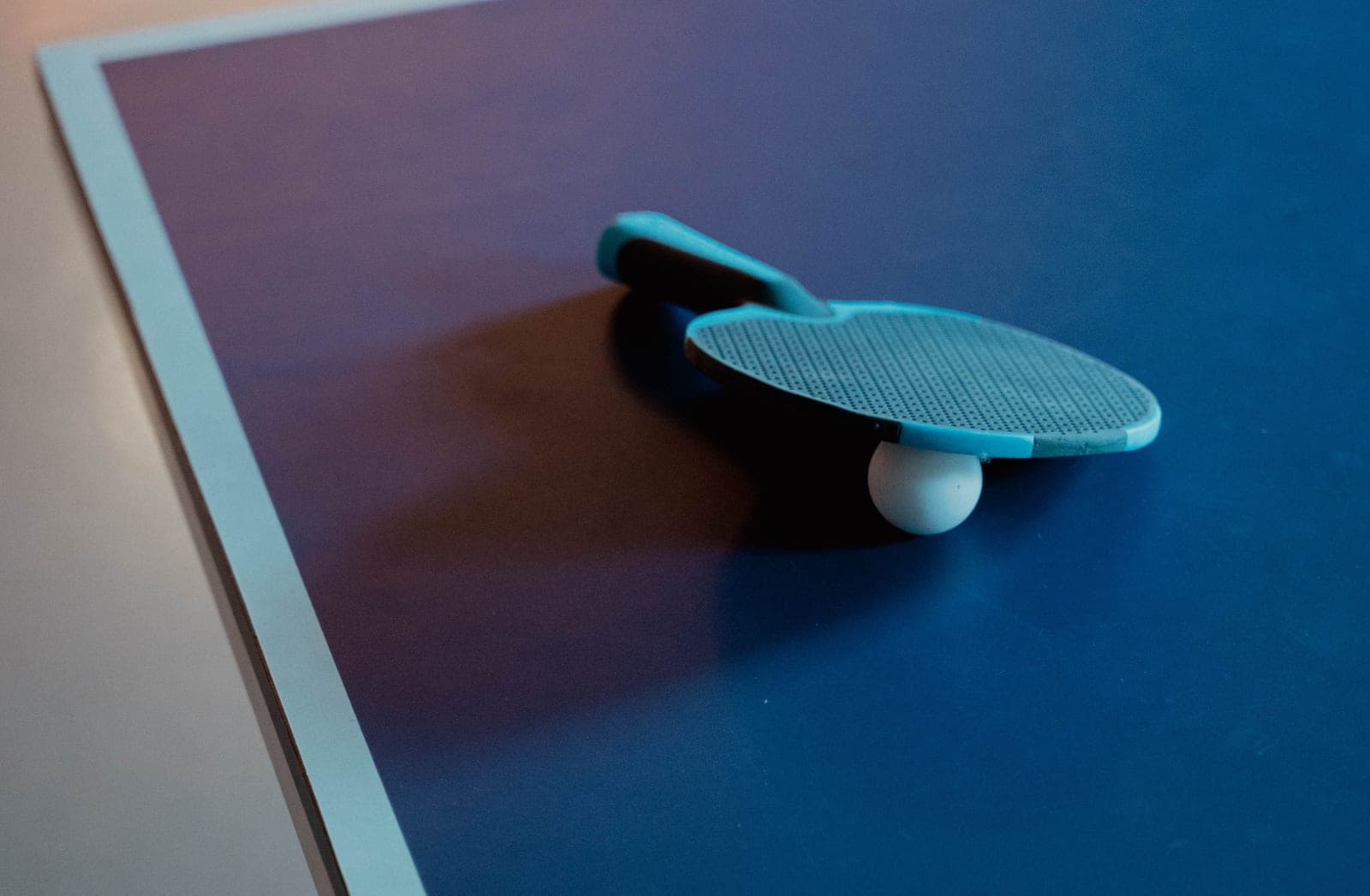
STIGA Advantage Indoor Table Tennis Table
The default family table: a full-size folding indoor table with STIGA's Quickplay assembly, aimed at first-time buyers.
The default family table: a full-size folding indoor table with STIGA's Quickplay assembly, aimed at first-time buyers. If the room clears a regulation table, buy a regulation table - every alternative on this page exists because of a room constraint, not because smaller is better.
- What works
- Regulation 9 x 5 ft play, so skills transfer anywhere
- Arrives largely assembled
- What does not
- Lighter frame flexes more than a reinforced undercarriage
- Entry-level top thickness
#2 · Full size with solo practice
JOOLA Inside 15 Indoor Table Tennis Table
A 15 mm top with a playback position so one person can practice alone. The thickness number is the whole spec conversation.
A 15 mm top with a playback position so one person can practice alone. In a room that clears a full table but a household where the second player is not always available, playback is the feature that turns the table from an event into a habit.
- What works
- Playback converts a single player into a session
- Folds and rolls for storage
- What does not
- 15 mm rather than a thicker tournament top
- Needs a parking space when folded
#3 · No floor to give
JOOLA Tetra 4-Piece Ping Pong Conversion Top
Four panels that turn a pool table into a table tennis table and stack behind a door afterwards. The storage story is the product.
Four panels that turn a pool table into a table tennis table and stack behind a door afterwards. This is the right answer for a room that already has a table in it, and the only answer for a room where nothing new can stay out.
- What works
- Uses the pool table's footprint, not new floor
- Panels stack flat and fit any stairwell
- What does not
- Plays at the pool table's height, below regulation
- Seams can show in the bounce
Skip it if: there is no pool table or sturdy table of the right size to lay it on. A conversion top needs a host.
Who should buy a midsize table
Midsize tables are usually bought for children, and the reasoning is half right. A smaller table does put the net within reach of a seven-year-old. What it does not do is teach the game - the distances are wrong, so the footwork and the timing do not transfer, and a child who learns on a midsize table starts again on a full-size one.
The better case for midsize is a room that simply cannot clear a regulation table and a household that wants a real, if smaller, game rather than a toy. In that situation it is clearly the right purchase. If the constraint is the child rather than the room, a full-size table with a lowered net or simply a few years of patience serves them better.
Indoor or outdoor is a size question in disguise
An outdoor table is the same 9 by 5 feet, but the top is a thin resin or aluminum-composite laminate instead of thick MDF, because MDF in the weather is ruined in a season. That means the millimeter figures you compare between indoor tables tell you nothing about an outdoor table, and comparing them directly leads people to think outdoor tables are badly made.
If the only space you have is outside, the size question is settled - full size, weatherproof top - and the real decision becomes the top material and the warranty. The indoor versus outdoor page covers that properly.
What we checked, and what we did not
Regulation dimensions are the ITTF figures, cited below. Midsize and compact dimensions are typical ranges across the category, not a standard, because no governing body defines them - confirm the figures for any specific model. The clearance recommendations are standard guidance plus arithmetic you can repeat. We have not played on these tables and publish no ratings.