Skip to content
Cue&Cabinet

Foosball & Air Hockey

Foosball and Air Hockey, Measured With the Rods Out

A foosball table's listed footprint is a lie of omission: the rods stick out. Air hockey's spec that matters is the blower. Both are covered here.

What decides this purchase: Rod extension beyond the cabinet (foosball) and blower voltage (air hockey)

A foosball table in a games room with a player's hands on the rods and clear floor on both sides

Start with these

The winner of each roundup in this section, with a direct link to Amazon.

These two games share a hub because they share a buyer and a room. Both are played standing, both are loud, both end up in a basement or a garage, and both have exactly one specification that decides whether the purchase works.

Foosball: the rods are part of the footprint

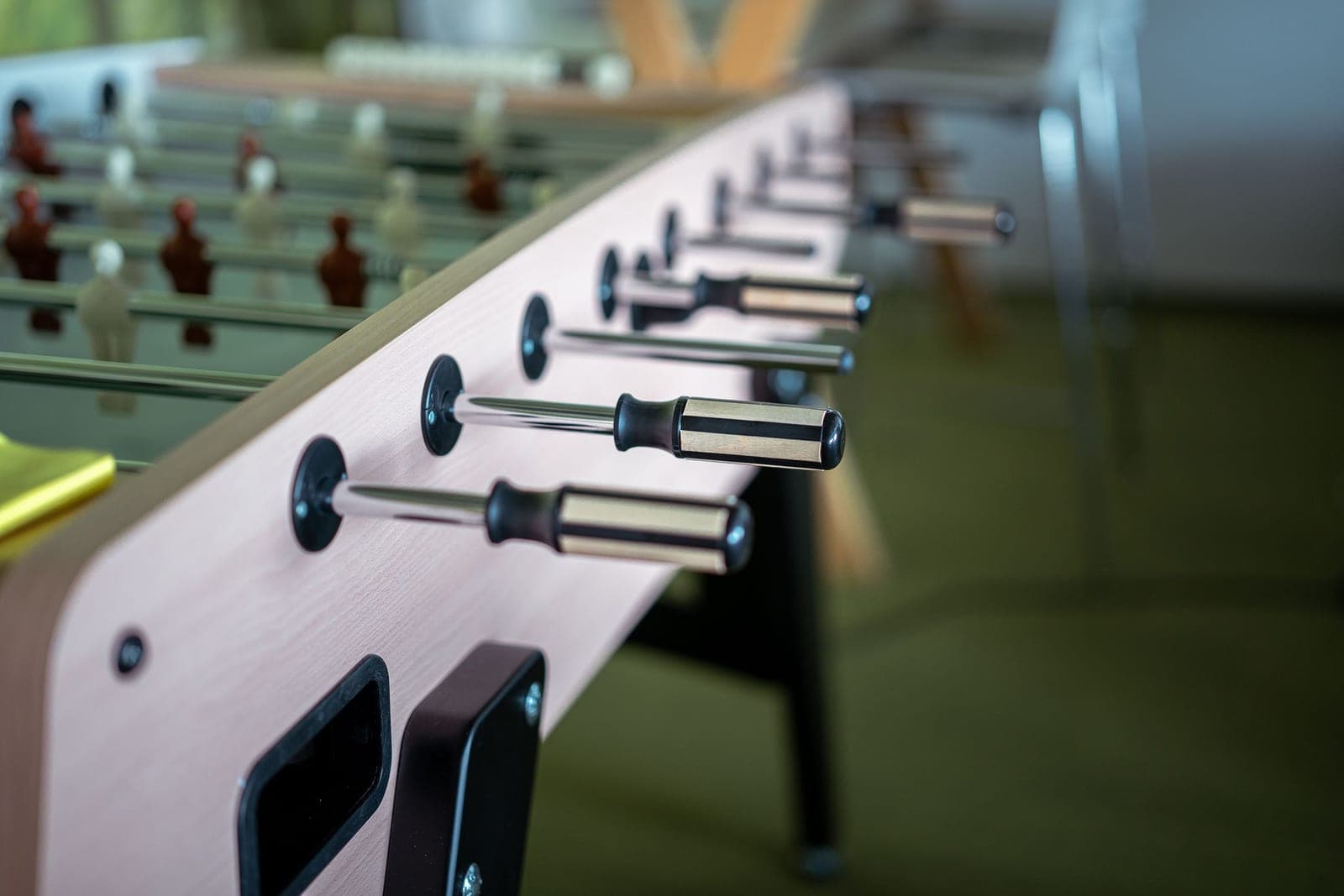
A regulation-size foosball table cabinet is around 56 inches long and 30 inches wide. That is the number in the listing. It is not the number you need, because on a through-rod table the rods slide out past the cabinet when a player pulls back - commonly 12 to 15 inches on each side at full extension, and more on the longest rods.

So a through-rod table in a 56 by 30 inch cabinet actually needs about 56 inches by 5 feet of floor, plus somewhere for the two players to stand. Push one side against a wall and half the rods stop moving. This is the single most common foosball buying mistake and it is entirely avoidable.

Telescoping rods solve it. A telescoping rod is hollow and the inner section retracts inside the outer one, so nothing projects past the cabinet. Telescoping tables can sit close to a wall, they are safer around small children, and they are the obvious answer in a tight room. The trade is feel: through rods are what competition tables use, and serious players prefer them.

Air hockey: the blower is the whole product

An air hockey table's playing character comes from how much air it pushes through the playfield. A 12-volt blower - the standard in family tables - moves enough air for a fun game and runs quietly. A 120-volt blower, which is what arcade tables use, moves far more, and the puck genuinely floats rather than skates. The difference is immediately obvious to anyone who has played in an arcade.

You can read the spec directly: look for the voltage and, where listed, the CFM figure. Most home tables under 6 feet run a 12-volt motor. Tables at 7 feet and up often step to 120 volts. If a listing does not state the blower voltage at all, assume 12 volts.

Size then follows: 5-foot tables are family tables for a spare room, 6.5 to 7.5-foot tables are what a dedicated game room should be looking at, and 8-foot is arcade. Add 2 feet of standing room at each end - players lunge - and 1 foot either side.

Honest advice about combo tables

Combination tables that promise foosball, air hockey, table tennis and pool in one frame are the most-returned product in this category. Each game gets a compromised version of itself: the air hockey blower is undersized because the cabinet also has to be a pool table, the pool cushions are shallow because the frame also has to carry rods. If you have the space for one good table, buy one good table. If you genuinely do not, buy the combo knowing exactly what the trade is.
Measure first

Start with your room, not the table

For foosball, measure the full width including 15 inches of rod travel on each side unless the table has telescoping rods. For air hockey, measure the length plus 2 feet of lunge room at each end.

Foosball rods extended out past the side of a cabinet, showing the real clearance needed

The picks

A tabletop foosball unit set up on a dining table in a small room

Picks

The Best Tabletop Game Tables

Tabletop foosball, air hockey and shuffleboard for rooms with no floor left - with what each one genuinely loses.

Head to head

A games room with both a foosball table and an air hockey table in use

Compare

Foosball vs Air Hockey

Space, noise, maintenance, age range and cost compared - and which one belongs in your room.

Foosball rods and handles along the side of a cabinet, partly extended

Compare

Telescoping vs Through Rods

Feel, safety and clearance compared between telescoping and through rods - and which one your room forces.

Guides

A puck and mallet resting on the surface of an air hockey table

Guide

Air Hockey Table Sizes

Every air hockey size from tabletop to 8 feet, the room each needs, and why size correlates with blower power.

Questions people actually ask

How much space does a foosball table need?
A regulation cabinet is roughly 56 by 30 inches, but on a through-rod table the rods extend 12 to 15 inches past each side at full pull, so plan for about 56 inches by 5 feet of clear floor plus standing room. Telescoping-rod tables need no side allowance at all.
What size air hockey table should I buy?
5 feet for a family spare room, 6.5 to 7.5 feet for a dedicated game room, 8 feet if you want the arcade experience. Longer tables also tend to carry stronger blowers, which is the actual reason they play better.
Why does my air hockey puck not float properly?
Almost always the blower. A 12-volt motor moves far less air than the 120-volt units in arcade tables. Blocked holes are the other cause - the playfield pinholes clog with dust and need vacuuming from above.
How long do air hockey tables last?
The playfield outlasts everything; the blower motor and the electronic scorer are the parts that fail. On a family table expect the scorer to go first, and expect the blower to be the thing that decides the table's life. Both are often replaceable.
Are telescoping foosball rods worse than through rods?
They feel different, and competition players prefer through rods for the directness. For a home table in a room with walls, telescoping rods are usually the better buy - they are safer, they need no side clearance, and the feel difference matters less than the space does.

Sources

By Brijon M.Last updated October 6, 2026Published October 6, 2026