Picks
The Best Ping Pong Paddles for a Home Table
A paddle costs a fraction of the table and changes the game more. Here is what the rubber does, what the blade does, and which rackets are worth the step up.
How these picks were made: from published manufacturer specifications, governing-body standards and the room arithmetic - not from first-hand use. We have not played on these tables. Read the method.
The paddle is the cheapest meaningful purchase in a game room and the one most likely to be bought badly. People spend months choosing a table by thickness and folded footprint, then play on whatever two paddles came in the box - which is roughly like buying a pool table and shooting with a broom handle. The table decides whether the bounce is true. The paddle decides what you can do with it.
Table tennis rackets are confusing in a particular way: the interesting part is the rubber, the marketing is about the blade, and the numbers on the box come from the manufacturer rather than from anybody's test. This page separates those out.
How these were chosen
We have not played a blind comparison with these rackets, and this site publishes no scores or ratings because of that. The selection below is made on published construction, on ITTF rubber approval where the maker claims it, and on four criteria that genuinely separate a ready-made racket from a bad one.
- Stated blade construction. Ply count, and whether carbon is in there. A racket that will not tell you what the blade is made of is a racket sold on its graphics.
- Sponge depth. The layer under the rubber topsheet. Thin sponge is controlled and dead; around 2 mm is the band where spin becomes available.
- Handle shape stated. Flared, straight or anatomic. It is the one ergonomic choice on the racket and it is not interchangeable.
- Replaceable, buyable rubber. A racket from a maker whose rubbers you can buy separately has a second life. A sealed-unit racket from an unknown brand is disposable.
The rubber is the paddle
A racket is a wooden blade with a layer of sponge and a sheet of pimpled rubber glued to each face. Virtually everything you feel comes from those two glued layers, and they are the parts that wear out. A five-year-old racket with glazed, hardened rubber plays worse than a cheap new one, no matter what the blade underneath cost.
Makers publish speed, spin and control numbers out of 100 for their rackets. Those are the manufacturer's own figures on the manufacturer's own scale - useful for comparing two rackets within one brand's range, meaningless across brands, and not a test result. Read them as a statement of intent: a racket rated high for speed and low for control is telling you honestly that it is fast and will not save you.
| Characteristic | Comes from | What you give up |
|---|---|---|
| Speed | Stiff blade, carbon layers, hard sponge | Margin for error - mistakes go long |
| Spin | Grippy topsheet, deeper sponge, flexible blade | Raw pace through the ball |
| Control | Thin sponge, soft all-wood blade | Ceiling - you cannot force a winner |
Quick picks
| # | Product | Best for | Blade | Price |
|---|---|---|---|---|
| 1 | STIGA Pro Carbon Table Tennis Racket | The step up that is worth taking | 7-ply with carbon, 2 mm sponge | |
| 2 |  Killerspin JET600 Spin N2 Table Tennis Racket | Spin over speed | 5-ply wood blade | |
| 3 | JOOLA Carbon Pro Table Tennis Racket | Hitting flat and hard | Carbonwood blade | |
| 4 | Killerspin Jet Black Table Tennis Racket | A grip that stays put | Flared handle | |
| 5 | Butterfly Balsa Carbo X5 Pro-Line Racket | A player who already knows their stroke | Balsa core with carbon | |
| 6 | 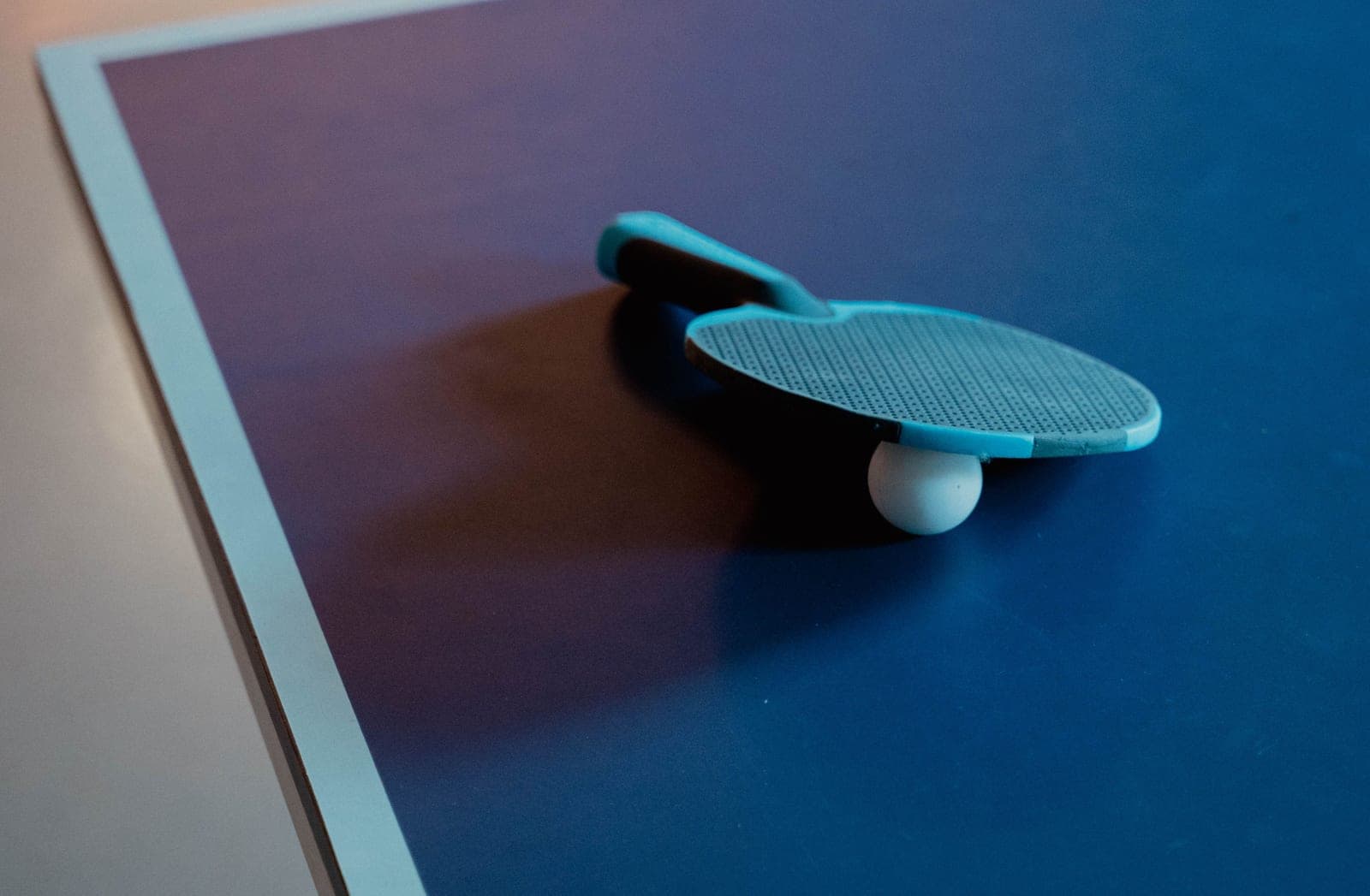 JOOLA Family Premium Ping Pong Paddle Set of 4 | A table four people share | 4 rackets, 10 balls, case | |
| 7 | STIGA Classic 4-Player Ping Pong Paddle Set | The spare-paddle drawer | 4 hardbat rackets |
The rackets
Five single rackets and two multi-paddle sets, ordered by who each is for.
#1 · The step up that is worth taking
STIGA Pro Carbon Table Tennis Racket
STIGA lists a seven-ply blade with carbon layers, 2 mm sponge and ITTF-approved rubber. The paddle most people step up to first.
STIGA lists a seven-ply blade with carbon layers, 2 mm sponge and ITTF-approved rubber. This is the racket most people move to once they have played enough on a hardware-store paddle to be annoyed by it, and it is the point where the ball starts doing what you asked rather than what it felt like.
- What works
- Carbon layers stiffen the blade, so the same stroke returns more speed
- 2 mm sponge is deep enough to hold and release spin
- ITTF-approved rubber, so it is legal if you ever join a club
- What does not
- Faster than a beginner wants - early mistakes go long, not short
- Rubber is a consumable and will dull in a year of regular play
Skip it if: You play twice a year and only want everyone to have a paddle.
#2 · Spin over speed
Killerspin JET600 Spin N2 Table Tennis Racket
A five-layer wood blade under spin-biased rubber. Built to bite the ball rather than to flatten it.
A five-layer all-wood blade under Killerspin's spin-biased rubber. All-wood flexes more than a carbon blade, which costs you top speed and gives you dwell time - the fraction longer the ball stays on the rubber, which is where spin comes from. For a looping, topspin-first player this is the better racket of the two.
- What works
- All-wood blade gives more feel and more dwell than carbon
- Rubber is biased toward grip rather than raw pace
- Forgiving on blocks and pushes
- What does not
- Slower through the ball than the carbon rackets here
- Flexier blade is less stable against a hard hitter
#3 · Hitting flat and hard
JOOLA Carbon Pro Table Tennis Racket
JOOLA lists a carbonwood blade built for speed. The fast end of the ready-made racket market, and it asks for a steadier hand.
JOOLA lists a carbonwood blade built for speed, and that is an accurate description of what it does. If your instinct is to drive through the ball rather than brush it, this rewards you. If your instinct is not yet settled, it will punish the stroke you have not learned to shorten.
- What works
- Fast off the bounce - genuinely quick blocks and counters
- Stiff blade means the ball leaves where you aimed
- Well-known maker, so rubber replacement is straightforward
- What does not
- Least forgiving racket on this page
- Flat-hitting bias makes heavy topspin harder to generate
Skip it if: You are buying your first proper racket. Start with the STIGA.
#4 · A grip that stays put
Killerspin Jet Black Table Tennis Racket
A flared-handle racket sold to beginners and club players alike. The flare is the feature: it stops the handle rotating mid-rally.
A flared handle widens toward the base so the racket cannot rotate out of your hand mid-rally. That sounds minor and it is not: a racket that twists a few degrees on contact sends the ball somewhere you did not choose, and most people blame themselves. Killerspin sells this one to beginners and club players alike, which is a fair description of who it suits.
- What works
- Flared handle locks the wrist angle in place
- Comfortable over a long session
- A sensible all-round racket rather than a specialist one
- What does not
- Flared handles suit shakehand grip and fight a penhold grip
- Mid-range rubber rather than the top of Killerspin's line
#5 · A player who already knows their stroke
Butterfly Balsa Carbo X5 Pro-Line Racket
Butterfly pairs a balsa core with carbon layers and sells it as a pro-line racket. The one here aimed at a player who already knows their stroke.
Butterfly pairs a balsa core with carbon layers and sells it as a pro-line racket. Balsa is light and soft, carbon is stiff and fast, and the combination gives you a racket that is quick without being heavy. It is the only option here aimed squarely at someone who can already describe their own game.
- What works
- Light in the hand for its speed
- Balsa and carbon together give pace without deadening touch
- Butterfly's blades and rubbers are the club standard
- What does not
- Wasted on a casual player - a family will not notice what it does
- Most expensive racket here
Skip it if: You cannot yet name your own grip and stroke. This is not the problem you have.
#6 · A table four people share
JOOLA Family Premium Ping Pong Paddle Set of 4
Four rackets, ten three-star balls and a storage case. The set that stops four people arguing over two paddles on a Saturday.
Four rackets, ten three-star balls and a storage case. This is the correct first purchase for almost every home table, and buying it alongside the table saves the evening where four people arrive and there are two paddles and one cracked ball. The case is the part that keeps them findable six months later.
- What works
- Four matched rackets, so nobody gets the bad one
- Ten three-star balls is a real supply, not a token two
- Case keeps the lot together and off the floor
- What does not
- Individually, none of these rackets is as good as the singles above
- Rubber on family-set paddles dulls faster
#7 · The spare-paddle drawer
STIGA Classic 4-Player Ping Pong Paddle Set
Four hardbat rackets and balls at the bottom of the market. Buy it for the spare-paddle drawer, not for your own hand.
Four plain hardbat rackets and balls at the bottom of the market. Buy this for the drawer - the paddles you hand to guests, the ones that live in the garage, the ones that can get stepped on. Do not buy it as the paddle you learn on, because a hardbat gives you almost no spin to work with.
- What works
- Cheapest way to make a table playable by four people
- Nothing to protect or worry about
- What does not
- Hardbat rubber generates very little spin
- You will outgrow it quickly if you play at all seriously
Skip it if: This is the only set you plan to own and you intend to play weekly.
Handle shape is the one thing you cannot adjust
Three shapes are sold, and they are not interchangeable preferences so much as different ways of holding a racket.
- Flared. Widens toward the base. The default for a shakehand grip, and the shape that stops the racket rotating in your hand on contact. If you do not know what you want, this is it.
- Straight. Even thickness along the handle. Suits players who rotate the racket deliberately between forehand and backhand strokes.
- Anatomic. Bulges in the middle. A minority taste; very comfortable for the hands it fits and awkward for everyone else.
If you hold the racket with your index finger flat on the rubber and your thumb on the other side - the penhold grip - a flared handle actively works against you and you want straight. Almost everyone in a home game room plays shakehand, so almost everyone wants flared.
Balls are not an afterthought
Competition balls are 40 mm plastic, and the star rating - one, two or three - describes roundness and consistency rather than toughness. Three-star balls bounce the same way twice, which matters far more than it sounds: a ball that is slightly out of round makes a true table look untrue and makes you doubt a shot you actually hit well.
Buy three-star for playing and one-star for a basement floor full of them. Orange and white are equally legal; pick whichever reads better against your table top, which on a dark table means white and on a light floor means orange.
Outdoors is a different product
If the table lives on a patio, conventional rubber-and-sponge rackets are the wrong tool. Weather gets into the sponge, the glue lets go, and a damp racket is a dead racket. Outdoor rackets use a composite or plastic body with a thin textured face - far less spin, far more survivability. Keep a set of those with the outdoor table and keep your good racket indoors.
That is part of the same decision as the table itself. The indoor versus outdoor comparison covers which way to go, and the outdoor table roundup covers the tables that survive it.
Match the racket to the table you actually have
A fast carbon racket on a thin tabletop is a mismatch. Table thickness determines bounce consistency, and a 12 or 15 mm top gives a lower, deader, slightly unpredictable bounce - which means the margin a fast racket demands is not there to be used. On a thin top or a conversion top over a pool table, a controlled all-wood racket is the better buy and the better game.
The table thickness page explains what each thickness band does to the bounce, and if you are playing on a conversion top over another table, read that first - the surface under it changes the answer again. If you are still choosing the table itself, the roundup is here.
The pattern this page belongs to
Every table in a game room has a small consumable that changes it more than another tier of hardware would: shuffleboard has wax, pool has cloth and a decent cue, and darts have the barrels. If you have a dart board in the same room, the steel-tip sets page makes exactly the same argument about weight that this one makes about rubber. Spend the small money. It is the best-value spending in the room, and it is the spending people skip.
The pool equivalent, for what it is worth, is choosing a cue properly - same principle, same neglect, same cheap fix.
What we have not done
We have not run a blind comparison, measured rebound speed or counted spin revolutions. The ply counts, sponge depths, blade materials, handle shapes and ITTF approvals above come from each manufacturer's published listing for the racket. The speed, spin and control numbers printed on racket boxes are the maker's own and are not reproduced here as if they were tests. Rubber dulls and prices move, so every button here goes to the live Amazon listing rather than a number we typed last month.