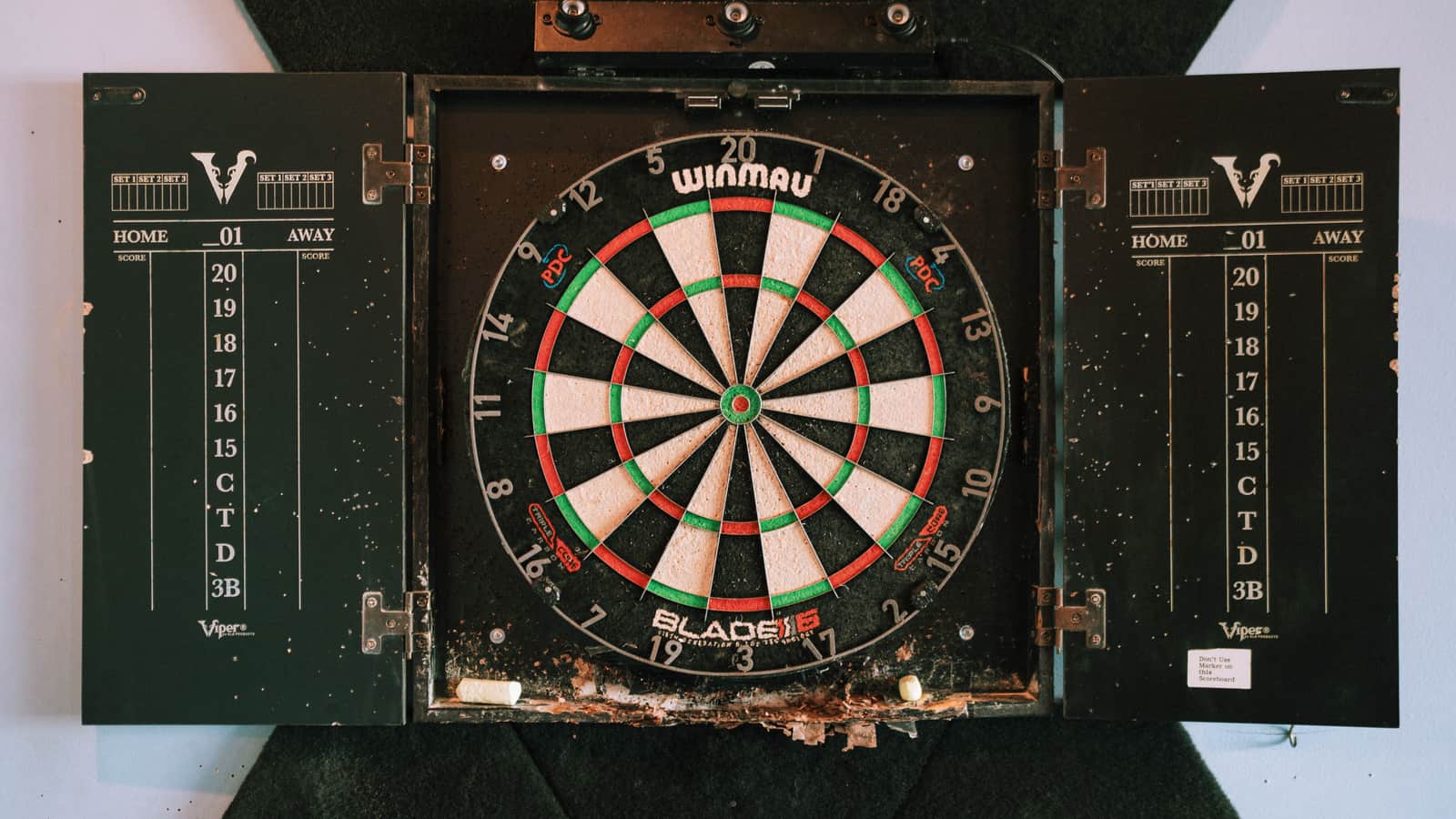
Guide
Dart Board Setup in a Small Room
Eleven feet of floor, two feet of wall either side, and you have a dart room. Here is how to find eleven feet.
How these picks were made: from published manufacturer specifications, governing-body standards and the room arithmetic - not from first-hand use. We have not played on these tables. Read the method.

The actual requirement
| Game | Floor run | Width | Ceiling |
|---|---|---|---|
| Darts | 11 ft | ~5 ft | Irrelevant |
| Bumper pool | 9 ft | 9 ft | Irrelevant |
| 9 ft shuffleboard | 13 ft | 5 ft 6 in | Irrelevant |
| 5 ft air hockey | 9 ft | 5 ft | Irrelevant |
| 7 ft pool table | 17 ft 2 in | 13 ft 11 in | 8 ft for the light |
Darts needs the smallest total area of anything here, and almost no width. That is why it fits where nothing else does.
Where to find 11 feet
- A hallway. The classic answer. Mount at one end, throw from the other. The only caveats are doorways opening into the throwing line and people walking through mid-throw.
- A garage side wall. Even a single garage is around 20 feet deep; mounting on the end wall gives more floor run than you need.
- The dead end of an L-shaped basement. The leg that is too narrow for a table is usually exactly right for darts.
- Across a room diagonally. A 9 by 9 foot room has a 12 foot 9 inch diagonal. It is unconventional and it works.
- A finished attic or bonus room. Ceiling height is irrelevant to darts, which makes sloped-ceiling rooms viable.
If the floor run is short
- Measure again from the board face, not the wall. A cabinet-mounted board sits 4 to 6 inches proud, which you get back.
- Reclaim the standing room. You need 2 feet behind the oche, not 3. In a tight room, 2 feet is workable.
- Open a door. A doorway behind the oche gives you the standing room without the floor area, provided nobody walks through.
- Do not shorten the throw. A board set up at 7 feet is not darts and the practice does not transfer. If you cannot make 7 ft 9.25 in plus 2 feet, use the wall for something else.
Safety in a tight room
- Nothing fragile within 3 feet of the board on either side. Bounce-outs travel sideways as often as back.
- Nothing walkable behind the oche. A doorway directly behind the thrower is a genuine hazard in a hallway setup.
- Hard floor plus steel tips equals chips. A mat solves it and marks the oche at the same time.
- Lighting from the front. In a narrow space the thrower's shadow is worse, because they stand closer to the only light.
Quick picks
| # | Product | Best for | Board type | Price |
|---|---|---|---|---|
| 1 | 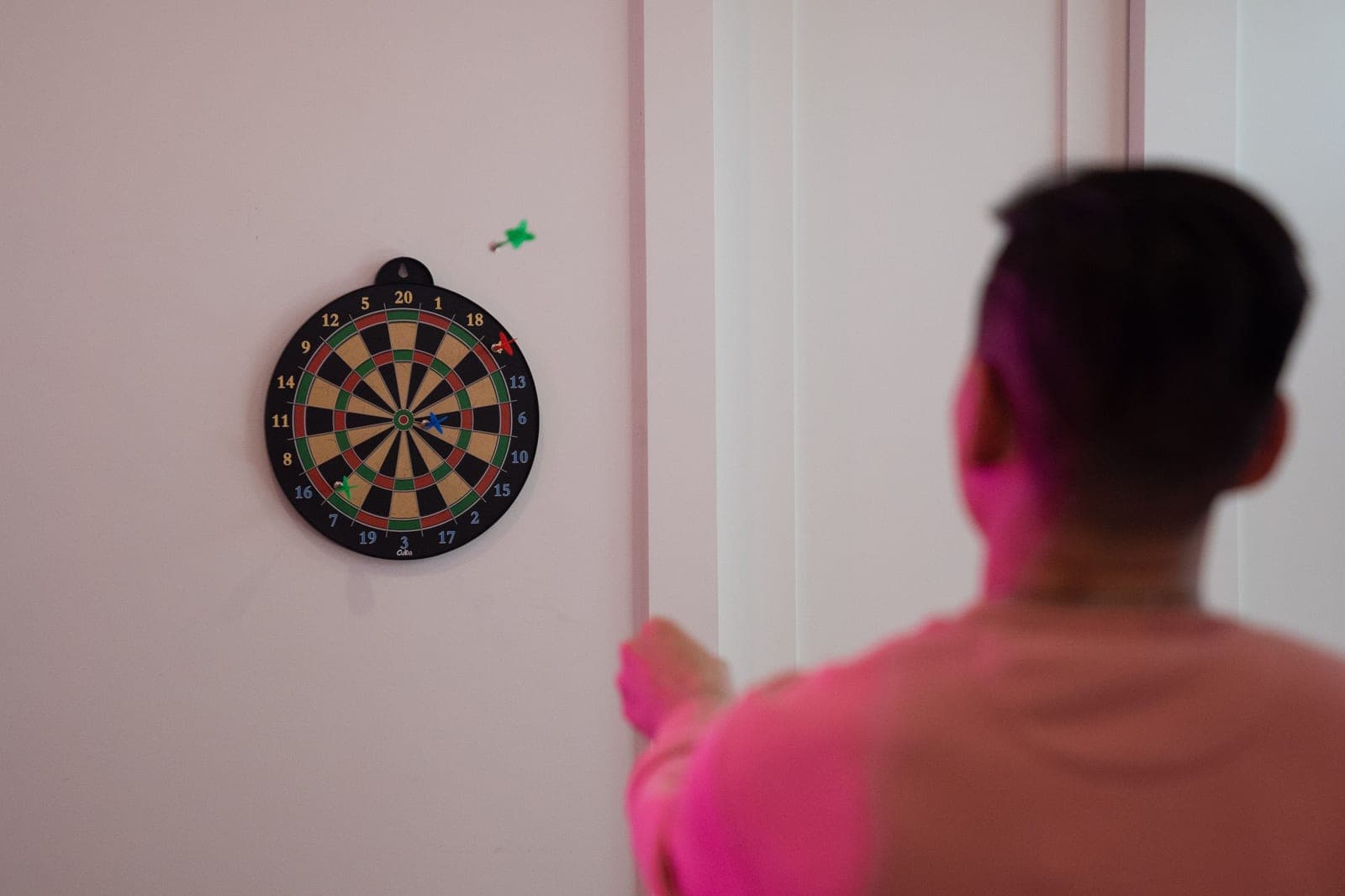 Viper Dart Throw Line Mat | A fixed oche in a shared space | Marked throw line | |
| 2 |  Gran Board 3s Bluetooth Electronic Dartboard | A quiet small room | Bluetooth, soft tip | |
| 3 | Viper Metropolitan Dartboard Cabinet with LED Light | A board that has to disappear | Lit cabinet, closing doors |
What makes a small-room setup work
#1 · A fixed oche in a shared space
Viper Dart Throw Line Mat
A mat with the oche marked at the regulation distance. Also the cheapest way to stop a dropped dart chipping a tile floor.
In a hallway or a shared room, a mat is what makes the setup repeatable - it goes down for a game and rolls up afterwards, and the oche is always in the same place.
- What works
- Repeatable oche without marking the floor
- Protects a hard floor
- What does not
- Has to be stored somewhere
#2 · A quiet small room
Gran Board 3s Bluetooth Electronic Dartboard
Bluetooth scoring to a phone app with online play. Also the quietest electronic board most people have thrown at.
In a small or shared space, noise and wall damage both matter more. A quiet soft-tip board scoring to a phone is the least intrusive setup available.
- What works
- Quietest board here
- Soft tips spare the wall
- What does not
- Needs a phone each session
#3 · A board that has to disappear
Viper Metropolitan Dartboard Cabinet with LED Light
A cabinet with integrated lighting, which solves the real problem: a ceiling light behind you puts your own shadow on the board.
In a room with another job, a cabinet that closes is what makes a dart board acceptable to everyone else in the house.
- What works
- Closes over the board
- Lights it without a ceiling fixture
- What does not
- Needs an outlet and stud mounting
Sources and method
The 7 feet 9.25 inch throw distance and 5 foot 8 inch board height are World Darts Federation regulations. The space comparisons use the same clearance arithmetic as the rest of this site.