Guide
How Much Does a Pool Table Cost?
The honest answer is that a pool table has two prices: the one on the listing and the one you pay to have a playable table in a room. The gap between them is slate, stairs and an installer.
How these picks were made: from published manufacturer specifications, governing-body standards and the room arithmetic - not from first-hand use. We have not played on these tables. Read the method.
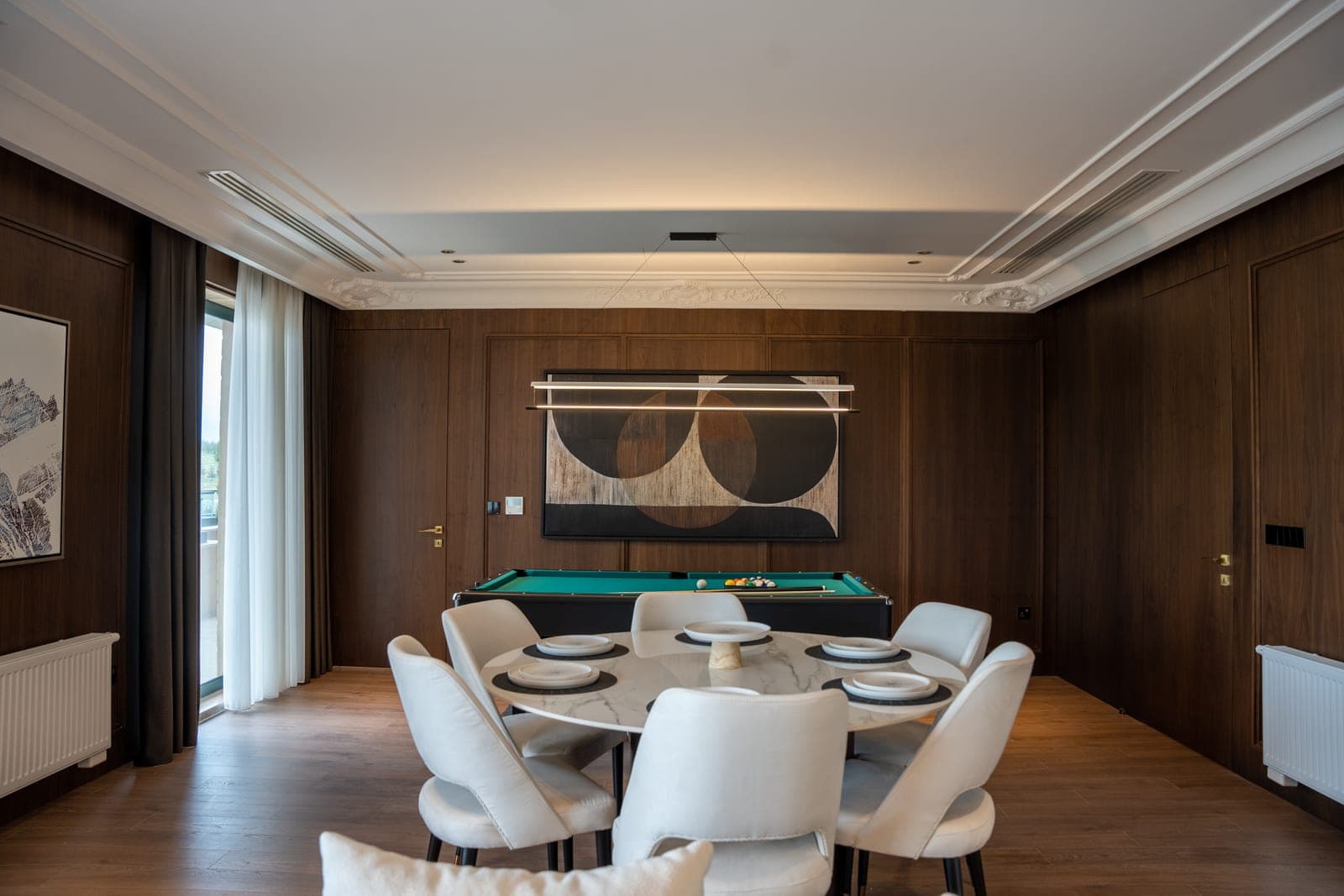
A pool table's price is set by four things, in this order: whether the bed is slate or not, the size, the cabinet construction, and whether the table needs professional installation. The first and last of those are the big steps - slate roughly doubles the weight and brings an installer with it - while size and cabinet finish move the number more gently. We do not publish prices on this site, so what follows is the structure of the bill rather than figures; check the current price on any listing before you plan around it.
The bed is the biggest single factor
Everything else about a pool table is a frame to hold the bed flat. A three-piece slate bed is a precision-ground stone surface, it is shipped in three heavy panels, and it has to be shimmed and seamed in place by somebody competent. A non-slate bed is a manufactured panel that ships as one piece and goes together with the frame. Those are different products with different supply chains, and that is where the price step comes from - not from branding.
What you get for the step is time. Slate stays flat for decades and can be re-covered and re-cushioned indefinitely, so a slate table is a purchase you make once. A non-slate bed is good from the day it is leveled and gradually stops being good, and when it stops there is nothing to re-cover. Slate vs MDF has the full comparison, including the cases where non-slate is genuinely the right answer.
| Line on the bill | Why it costs what it does | Can you defer it? |
|---|---|---|
| Slate vs non-slate bed | Different product, different shipping weight | No - it is the table |
| Size (7 / 8 / 9 ft) | More material, more slate, more cloth | No |
| Cabinet and finish | Hardwood and veneer vs MDF and laminate | No |
| Delivery | Weight and whether there are stairs | No |
| Professional installation | Required for slate; leveling and seaming | No, on slate |
| Cloth | Worsted vs woolen blend | Yes - until it wears |
| Ball set | Phenolic vs polyester | Yes - but it is the best-value upgrade |
| Table light | A fixture plus a ceiling mounting point | No, in a basement |
| Cues, rack, cover, brush | Accessories | Partly |
The costs people do not see coming
Three lines catch people out, and all three are logistics rather than equipment. The first is delivery to the room rather than to the curb: a slate table arriving at a house with a narrow turning staircase is a different job from one going into a ground-floor room, and it is priced accordingly. The second is installation. A slate table is not assembled, it is installed - shimmed level, slate seams filled, cloth stretched - and a badly installed slate table plays worse than a well-assembled non-slate one.
The third is lighting. A pool table in a basement without a dedicated light over it is unusable, and the fixture needs a mounting point in the ceiling at the right place, which is sometimes an electrician. It is not a large sum next to the table, but it is not optional either, and it is the one most often left off the plan. The pool table lights page covers the fixtures and light height covers the hanging figure.
Three purchases at three points on the curve
The table most budgets should land on, the slate step up with its install included in the thinking, and the cloth upgrade that beats replacing a table you already own.
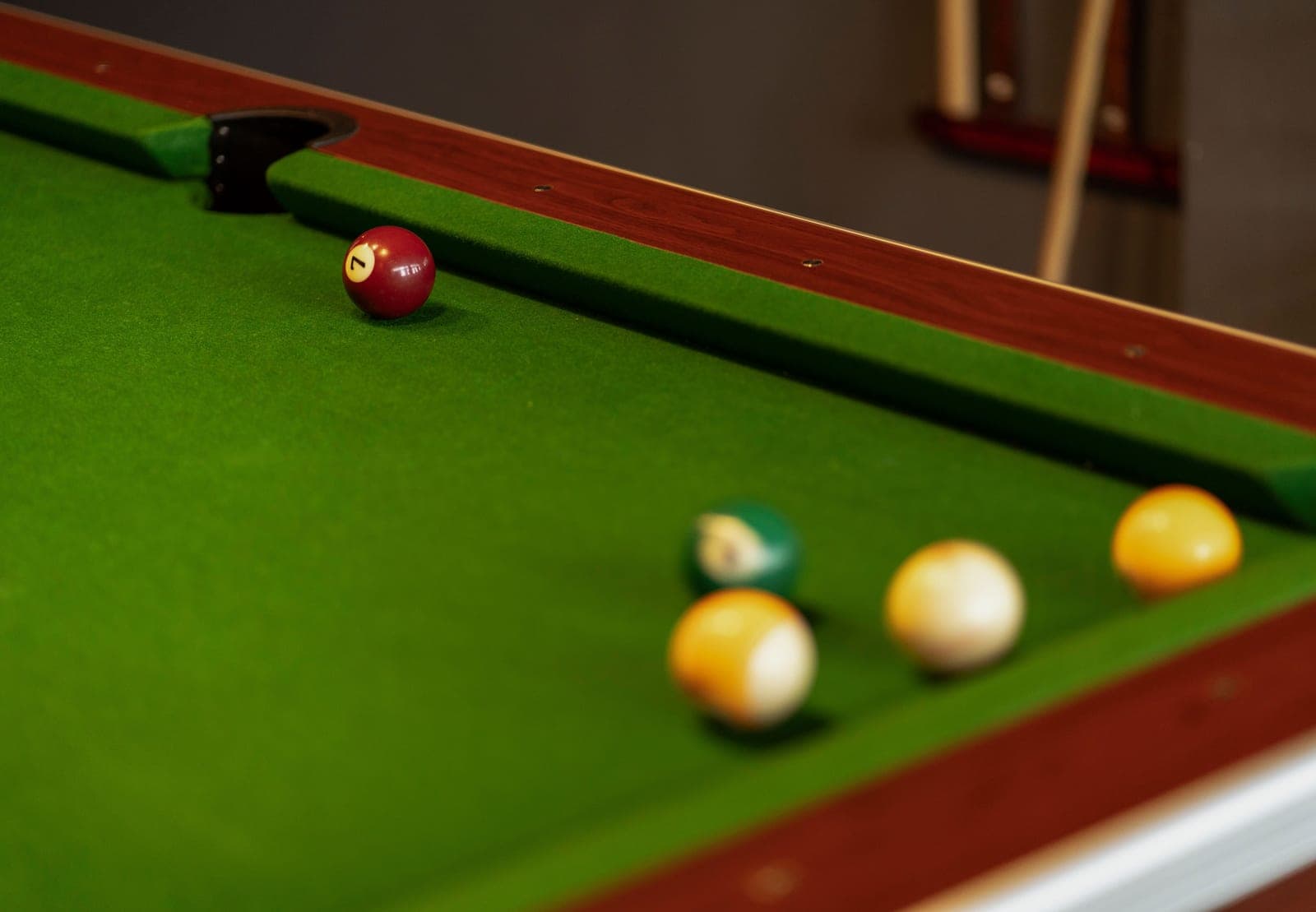
#1 · Where most budgets should land
Fat Cat Tucson 7 ft Pool Table
A 7-foot arcade-style table with an automatic ball return, aimed at basements that cannot take a 4-inch slate bed.
A 7-foot arcade-style table with an automatic ball return, aimed at basements that cannot take a 4-inch slate bed. This is the honest center of the market: a real table, assembled by two people in an afternoon, with no installer invoice attached. The money you are not spending on slate and installation is the money that buys you the room's light, a decent ball set and a cover - all of which do more for how the table plays than a slightly better bed would.
- What works
- No installer required, which removes a whole line from the bill
- 7-foot geometry at the price point most people are actually shopping
- Ball return costs nothing extra and keeps casual games moving
- What does not
- A non-slate bed will not hold a true roll for decades
- Rail bulk from the return channels eats a little clearance
#2 · The slate step up
Playcraft Rio Grande Slate Pool Table
Three-piece slate on a hardwood frame. Heavy enough that the floor, the stairwell and the installer all become part of the buying decision.
Three-piece slate on a hardwood frame. Heavy enough that the floor, the stairwell and the installer all become part of the buying decision. That sentence is the price explanation: when you move up to slate, you are not only buying a better bed, you are buying a delivery that needs more people and an installation that needs someone who has done it before. Budget for the install as a separate line from the start and the decision gets much clearer.
- What works
- Three-piece slate is the only bed that stays flat for decades
- Worth recloth and recushion work later, which spreads the cost over years
- Holds its value in a way a non-slate table does not
- What does not
- Installation is a real, separate cost and not optional
- The stairwell may rule it out regardless of budget
#3 · The upgrade instead of a new table
Simonis 760 Billiard Cloth
Worsted cloth: a tight-woven surface with no nap, so the ball rolls straighter and the cloth lasts. The standard recloth upgrade.
Worsted cloth: a tight-woven surface with no nap, so the ball rolls straighter and the cloth lasts. The standard recloth upgrade. It belongs on a cost page because it is the cheapest route to a better-playing table by a wide margin - a fresh worsted cloth on an existing slate bed plays better than a new mid-price table, for a fraction of the outlay, and it postpones the replacement decision by years.
- What works
- Transforms an existing table for far less than replacing it
- Lasts significantly longer than a woolen blend under the same play
- No nap, so the roll is directionally consistent
- What does not
- Fitting it well is a job for someone experienced - add that to the cost
- Faster than most casual players expect
Size costs less than people expect, and room costs more
Going from a 7-foot to an 8-foot table is a modest increase in material and a modest increase in price. What it is not modest about is room: with full 58-inch cues an 8-footer needs 18 ft by 14 ft 4 in of clear floor, against 17 ft 2 in by 13 ft 11 in for a 7-footer. Those numbers look close until you measure your basement, because the clearance requirement grows at both ends and both sides simultaneously - and almost no home room clears either figure without short cues somewhere.
So the real cost of going bigger is usually paid in room rather than in money, and the mistake it produces is expensive in a different way: an 8-foot table in a 7-foot room gets played for a month and then resented for a decade. The room size guide has the chart for every size and both cue lengths; measure before you price anything.
Where to spend first, if the budget is fixed
The ordering that produces the best room for a fixed amount is not intuitive. Spend on the installation before the table - a correctly leveled mid-price table plays better than a badly leveled expensive one, every time. Then spend on the light, because an unlit table is not a table. Then on the ball set, which changes every shot and costs a fraction of anything else here. The bed is the last place to spend marginal money, not the first.
That ordering also explains why non-slate tables are a reasonable purchase rather than a compromise for most homes: the money saved on slate and installation buys the light, the balls, the cover and two decent cues, and the resulting room is better than a slate table on its own in the dark. Is a pool table worth it is the honest test to run before any of this, and the accessories page covers which extras actually earn their place.
Running costs, over the years
A pool table is not a subscription, but it does consume a few things. Chalk, constantly, and it is trivial. Cloth, every several years depending on play - this is the one real recurring cost, and brushing the table extends it substantially. Cushions, perhaps once in the life of a slate table, when the rubber hardens and the bounce goes dead. Tips on cues, occasionally. A non-slate table has a different pattern: nothing is economically replaceable, so instead of maintenance there is eventually a replacement.
How long a pool table lasts goes through which component fails first on each type, and the felt guide covers the recloth decision in detail.
Sources and method
Table sizes, playing surfaces and the clearance arithmetic come from the published equipment specifications cited below. Construction details are each manufacturer's own listed specifications. We publish no prices on this site - the Amazon links show the current price at the time you click them - and no figure on this page is an estimate of what anything costs, because an invented number would be worse than none. The spending priorities are reasoning from how the components work, not test data.