Picks
The Best Dart Mats
A dart mat does two jobs - it saves your floor and it marks the throw line - and the second one is only correct if the mat's front edge sits where the maker assumed it would. Nobody publishes that assumption.
How these picks were made: from published manufacturer specifications, governing-body standards and the room arithmetic - not from first-hand use. We have not played on these tables. Read the method.
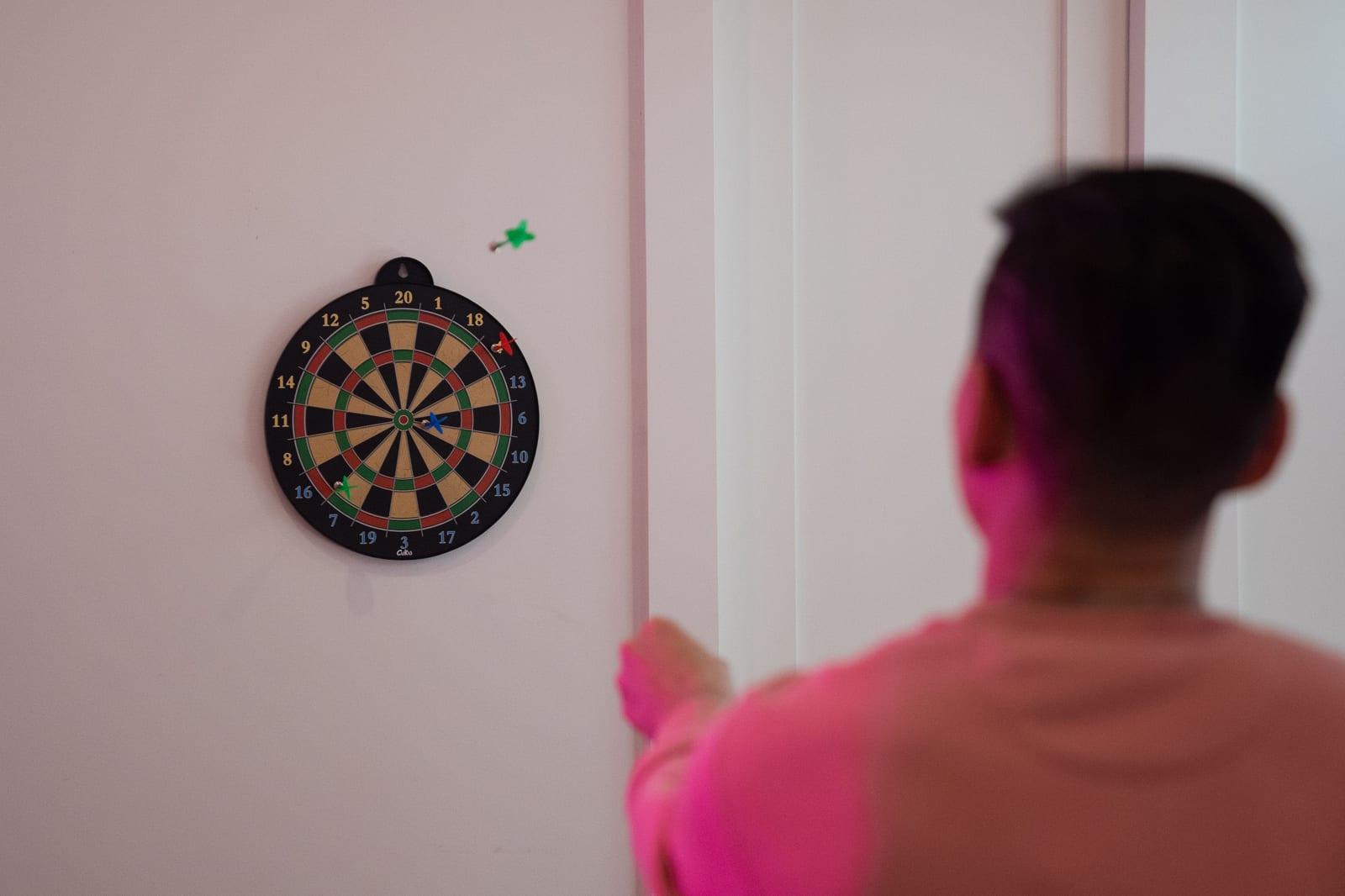
A dart mat is sold as one product doing one job. It is actually doing two, and only one of them is hard to get wrong. Protecting the floor from a bounced-out dart is a matter of thickness and material. Marking the throw line correctly is a matter of geometry, and the mats are sold as though it were not.
The World Darts Federation specifies the throw distance as 7 ft 9 1/4 in for steel tip, measured from the face of the board. Every mat with a printed oche has that distance built into it at a fixed position. Which means every mat is making an assumption about where its front edge will sit relative to your board - and we could not find a single maker that states what that assumption is.
The measurement problem, stated plainly
Look at the one product in this category that publishes its distances. The Viper throw-line marker's listing says it sets 7 feet 9-1/4 inches from the wall for steel tip and 8 feet from the wall for soft tip. The WDF measures from the board face. Those are different points, and the gap between them is however far your board's playing surface sits forward of the wall.
For a bristle board screwed flat to the wall that gap is small - the thickness of the board and its mounting bracket. For a board inside a cabinet it is the whole internal depth of the cabinet, and for a board behind a thick surround the surround sets it. In both of those cases a line laid at 7 ft 9 1/4 in from the wall puts you closer to the board than the rule allows, by exactly the depth you added.
This is not a criticism of the product - it is the clearest listing in the category and the only one that tells you anything. It is a warning about what a printed line on a mat can and cannot do for you. Height and distance has the measurements and the diagonal check that catches this, dart board cabinet dimensions covers how much depth a cabinet adds, and dart board surround size covers the other thing that moves the face forward.
Quick picks
| # | Product | Best for | Oche | Price |
|---|---|---|---|---|
| 1 | 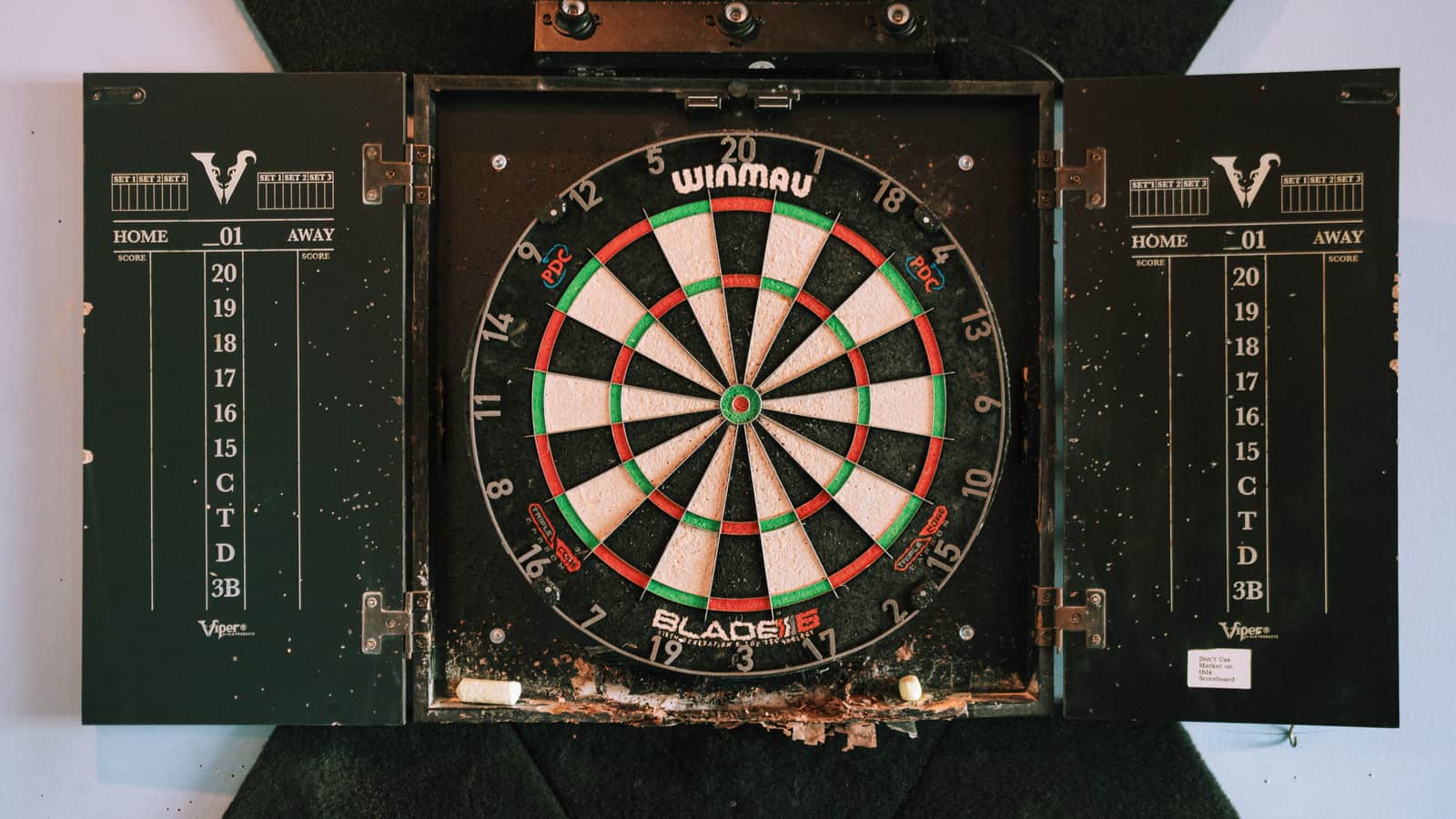 Winmau Pro Zone Precision Dart Mat | A line you can find with your foot | Raised, integrated | |
| 2 | Viper Padded Pro-Tech Dart Mat | A tile, laminate or concrete floor | Printed, 0.25 in thick | |
| 3 |  Winmau PDC Pro Zone Dart Mat | A flat mat that rolls up | Printed, PVC | |
| 4 |  Bull's Rubber Dart Mat with Raised Oche | A board over carpet | Raised, rubber | |
| 5 |  Viper Dart Throw Line Marker | The budget pick: a line and nothing else | Strip, 23.5 x 3.5 in |
The mats
Five mats ordered by what they solve rather than by price: a raised oche first because it is the only functional difference in the category, then the hard-floor mat, then the roll-up mat, then the carpet mat, then the strip that is just a line.
#1 · A line you can find with your foot
Winmau Pro Zone Precision Dart Mat
Listed at 3.0 x 0.6 m with the official tournament oche raised into the surface rather than printed on it. The raised line is the point: you can find it with a foot.
The pick, and the feature that earns it is one you notice within a week of owning a flat mat: the oche is raised rather than printed. Retail listings put the mat at 3.0 by 0.6 meters with the tournament oche built into the surface as a tactile ridge rather than printed on it. A raised line means you can set your foot against it without looking down, which is how people actually throw - the printed-line alternative requires you to check your feet between visits to the board, and in practice nobody does, which is how the quietly-creeping foot fault becomes a habit. Nobody publishes the ridge height, but it is low enough that the mat still rolls and high enough to find blind, which is the whole job.
- What works
- A raised oche you can locate by feel, which is the one functional difference in this whole category
- 3.0 by 0.6 m as listed, which is 9 ft 10 in - long enough to cover the throw distance with room behind it
- Winmau's listings for the Pro Zone range are the most specific in the category about oche type
- What does not
- The integrated oche is the official tournament line, which is the steel-tip distance, so a soft-tip player standing at 8 ft is back on a printed line or no line at all
- Any raised ridge is a trip edge in a dark room and a thing a vacuum catches
- Winmau's own site was unreachable while this page was written, so every figure here is from retail listings rather than the maker
Skip it if: you play soft tip. The raised line is in the wrong place for you and you are paying for it.
#2 · A tile, laminate or concrete floor
Viper Padded Pro-Tech Dart Mat
An EVA foam mat listed at 119 x 24.25 in and a quarter inch thick, with embossed steel-tip and soft-tip throw lines. Stops a dropped dart chipping a tile floor.
The floor-protection pick, and the one to buy if your board is over anything hard. The listing gives 119 inches long by 24.25 wide by a quarter inch thick in EVA foam, with embossed throw lines for both steel tip and soft tip, made in the USA. The quarter inch of foam is the specification that matters: a steel tip bouncing out of a board at head height and landing point-first on tile either chips the tile or blunts the point, and a quarter inch of foam absorbs that where a thin PVC sheet does not. It also carries both tip distances, which the raised-oche mats generally do not.
- What works
- A quarter inch of EVA foam, which is genuinely thick enough to save both the floor and the dart point
- Embossed lines for steel tip and soft tip, so a mixed household gets both distances
- 119 x 24.25 in as listed, the longest mat here, with the most room behind the line
- What does not
- The lines are embossed rather than raised into a ridge, so you still have to look down to find them
- One listing notes it needs a break-in period of around four hours of use to settle to the described size, which is an odd thing to have to plan for
- Listings disagree on the exact figures - we also saw 117 x 24 in and a thickness given as 125 mil - and it was out of stock at one major retailer while this page was written
Skip it if: the board is over carpet. Foam on carpet is softness on top of softness and the mat will not lie flat.
#3 · A flat mat that rolls up
Winmau PDC Pro Zone Dart Mat
Winmau's plain PVC mat, listed at 118 x 24 in with a printed official oche line. The flat, roll-up version of the Pro Zone.
The plain version of the Pro Zone, and the right buy if the mat has to disappear between sessions. It is listed as a PVC mat at 118 by 24 inches with an official printed oche line, and PVC is the material that rolls into a tube and stays rolled rather than remembering a crease the way foam does. The trade against the raised-oche mat above is exactly the one you would expect: you get the length and the line, you do not get something you can feel. For a board in a shared room that has to be cleared away, that trade is usually worth making.
- What works
- PVC rolls up and stores, which a quarter-inch foam mat does badly and a 12 kg rubber mat does not do at all
- 118 x 24 in as listed, effectively the same footprint as the raised Pro Zone
- The cheapest Winmau route to a full-length mat with a correct printed line
- What does not
- Printed line only, so the foot-fault problem a raised oche solves is still yours to manage
- Thin PVC does little for a hard floor - it marks the line, it does not protect the tile
- The listing's units are internally inconsistent, giving both 118 x 24 cm and 24 by 118 inches for the same product, and only the inch reading is dimensionally possible
Skip it if: your floor is tile or concrete. Buy the padded mat and accept that it lives on the floor.
#4 · A board over carpet
Bull's Rubber Dart Mat with Raised Oche
A rubber mat with a raised oche at the official throwing distance. Rubber is the weight that keeps a mat flat on carpet.
The carpet answer, because on carpet the problem is not protection but geometry: a light mat on a deep pile will not lie flat, it creeps when you step on it, and a mat that creeps has moved your oche. Rubber is the material that solves that by weight alone, and this one is listed as a rubber mat with a raised oche at the official throwing distance - so you get both the mass that keeps it put and a line you can feel. It is the oldest listing on this page by some distance, which is worth knowing before you order.
- What works
- Rubber mass is the only reliable fix for a mat that creeps on carpet
- A raised oche rather than a printed line, which is the feature worth paying for
- Rubber also survives a garage floor and a damp basement better than foam or carpet does
- What does not
- No published length, width or thickness on the listing we read, which on a mat is most of the specification
- A long-standing listing rather than a current-season product, so confirm it is still shipping before you commit
- Rubber mats in this category are heavy and do not roll up - this is a mat that stays where you put it
Skip it if: you need to know the dimensions before you buy. They are not published, and the Winmau mats are.
#5 · The budget pick: a line and nothing else
Viper Dart Throw Line Marker
A peel-and-stick strip listed at 23.5 x 3.5 in that marks the oche and nothing else. The cheapest correct answer if your floor needs no protecting.
The budget pick, and the honest answer for anyone whose floor needs no protection - a garage slab, a basement with vinyl plank, a room where a dropped dart is simply not a problem. It is a peel-and-stick plastic strip listed at 23.5 by 3.5 inches that marks the oche and does nothing else, for a fraction of any mat here. It is also the most useful listing in this category for a different reason: it is the only one that publishes the distances it sets, giving 7 feet 9-1/4 inches from the wall for steel tip and 8 feet from the wall for soft tip. Read the next section before you lay it down, because that wording is doing a lot of work.
- What works
- Costs a small fraction of a mat and does the oche job completely
- The only product here that publishes the actual distances it marks
- A strip raises the line without raising the whole floor, so nothing gets caught by a vacuum
- What does not
- Zero floor protection and zero dart-point protection - a bounce-out lands on your actual floor
- Published as a distance from the wall, where the governing rule is measured from the board face, which is not the same point
- Adhesive on a dusty garage slab is a gamble, and lifting it later can take a layer of paint with it
Skip it if: the board hangs over tile, laminate or hardwood. You will spend the saving on the floor.
How these were chosen
We have not thrown on any of these mats, measured one, or left one on a carpet for a month, and this site publishes no scores, star ratings or review counts, because it has not tested anything and will not imply that it has. The criteria below are about which published facts in this category are worth anything.
- Oche type is in the spec column on every entry. Raised or printed. It is the only difference between two mats of the same size that changes how you throw, and roughly half the listings in the category do not make it clear.
- Published length is checked against the throw distance. 7 ft 9 1/4 in is 93 1/4 inches. A 118 or 119 inch mat leaves about two feet behind the line, which is adequate and not generous - if you take a step back to throw, you are standing off the mat.
- Material is reported because it decides the floor it suits. Quarter-inch foam for hard floors, thin PVC for storage, rubber for carpet. A mat that is wrong for your floor fails at the only job it cannot get wrong.
- Figures the maker does not publish are marked as missing, not filled in. One mat here has no published dimensions at all and its entry says so twice.
- Stock and listing age were checked. Three of the mats we researched for this page were sold out at the manufacturer's own store when we looked, and they are discussed below rather than recommended.
Raised oche or printed line
This is the real decision, and it is worth more than the size or the material. A printed line has to be looked at. A raised line can be found with the side of a shoe, which means you can set up without taking your eyes off the board, which means your feet end up in the same place every visit rather than creeping forward over an evening.
The cost of a raised oche is that it is a ridge on your floor. Nobody publishes the height of it, and that is the point - a ridge you can feel through a shoe is by definition a ridge a vacuum head or a toe in a dark basement can catch. In a dedicated games room that is nothing. In a shared living room with a mat that gets rolled up between sessions, a flat PVC mat is the more sensible object even though it is the worse oche.
A raised oche is also, on the listings we read, a steel-tip feature. The raised line is set at the steel distance; soft-tip players throwing from 8 feet are back to a printed mark or nothing. Steel tip vs soft tip covers why the two distances differ, and if your house plays both, a mat with both lines embossed is worth more than a ridge at one of them.
Carpet, hard floor, and why the answer is different
On tile, laminate, hardwood or a concrete slab, the mat is there to catch a dart. A bounce-out leaves the board at some speed and lands point-first, and the two things it can damage are the floor and the dart. A quarter inch of EVA foam handles both. A thin PVC sheet is a line with no cushion, and a hard floor under thin PVC is still a hard floor.
On carpet, the floor is already protected and the mat's job changes completely: it is there to stop the oche moving. A light mat on a deep pile will not lie flat, and it creeps a half inch every time you push off against it, which over an evening quietly moves the line. Weight is the only fix - rubber, and the heavier the better. The heaviest mat we found in researching this page is a 12 kg rubber tournament mat, and the weight is the whole reason it exists.
Either way the mat is the second line of defense and the wall behind the board is the first. Wall protection and the surrounds and backboards roundup cover the part of the room that actually takes the damage - most bad darts hit the wall, not the floor.
Mat length against the room you have
The throw distance is 93 1/4 inches from the board face, and the long mats here are 118 or 119 inches, so a mat laid from the wall gives you roughly two feet of standing room behind the line. That is enough to stand on and not much more. Players who step back before throwing, or who stand back for a stretch at a double, are off the back of the mat - which is fine on carpet and noticeable on tile.
It also means the mat is not the thing that tells you whether the room works. You need about 5 feet of clear floor behind the oche to play comfortably and a clear width either side of the board, and a mat does not create any of that. Throw line setup in a small room is the page for a room that is genuinely tight, and it is worth reading before you buy a mat for a space where the answer may be a shorter throw line and an honest house rule.
What we left off, and why
Three mats that would otherwise belong here are not on the list because they were sold out at the manufacturer's own store while this page was written: a 3 m by 1 m carpet mat with a latex rubber underlay and official steel and soft-tip throw lines, a 9 ft 8 in by 2 ft heavy-duty rubber tournament mat weighing 12 kg with a raised defense zone described as twice the mat thickness at the oche, and a third rubber mat in the same range. They are good designs - the 12 kg one is the definitive carpet answer on paper - and we are not going to send you to a buy button for something the maker is not currently shipping.
We also left off the unbranded mats that dominate the search results. Several publish sensible-looking dimensions around 300 by 60 cm with both throw lines marked, and some are perfectly good objects. The reason they are not picks is that there is no maker behind the listing to check a figure against, which on a product whose entire value is a measurement being in the right place is the wrong kind of unknown to accept.
Prices, and why there are none on this page
The spread here is wider than the products justify, and it moves: a peel-and-stick strip and a tournament rubber mat are the same category and differ by more than an order of magnitude, the branded mats are discounted against each other constantly, and availability is genuinely unstable - one of the mats here was out of stock at a major retailer and three others were sold out at their own maker on the days we checked. A printed number would be wrong by the time you read it. Every button goes to the live listing instead. In rough brackets: a throw-line strip is the cheapest thing in any darts basket, a PVC or foam mat is a low-to-mid two-figure purchase, and the heavy rubber tournament mats are the top of the category.
What we have not done
We have not thrown on, measured, weighed or lived with any of these mats. Every dimension, thickness, material, oche type and distance above is quoted from the maker's or a stocking US retailer's own listing, checked as currently sold while this page was written, and the throw distance of 7 ft 9 1/4 in is the World Darts Federation's own. Winmau's own site was unreachable on every attempt while this page was written, so the Winmau figures are retailer-published rather than manufacturer-published and the entries say so. The geometry argument - that a line set from the wall is not a line set from the board face - is arithmetic from the published numbers, not a test result, and it is the reason this page tells you to check the distance with a tape measure instead of trusting any mat.
Questions people actually ask
Do I need a dart mat?
Is the throw line on a dart mat accurate?
What is the regulation dart throw distance?
Is a raised oche better than a printed line on a dart mat?
What is the best dart mat for carpet?
How long should a dart mat be?
Will a dart mat stop darts bouncing out?
Can I just use tape instead of a dart mat?
Sources
- World Darts Federation - Playing and Tournament Rules (board height and throw distance)
- Amazon - Winmau Pro Zone Soft Feel Dart Mat with Raised Oche Line, model 8220 (listed as a full-length mat with a tactile raised oche built into the surface and a non-slip backing; no dimensions published on the listing)
- CricketDirect - Winmau Pro Zone Precision Blade 6 Soft Feel Dart Mat with Integrated Oche (listed 3.0 m x 0.6 m, full-length soft-feel mat, official tournament oche measurements with an integrated raised oche)
- Amazon - Winmau PDC Pro Zone Dart Mat (listed PVC, 118 x 24 in, official printed oche line)
- Amazon - Viper Padded Pro-Tech Dart Mat Throw/Toe Line (listed 119 in L x 24.25 in W x 0.25 in thick, EVA foam, embossed steel-tip and soft-tip lines, made in USA)
- Amazon - Viper Dart Throw/Toe Line Floor Marker (listed 23.5 x 3.5 in; states 7 ft 9-1/4 in from the wall for steel tip and 8 ft from the wall for soft tip)
- Amazon - Bull's Rubber Dart Mat with Raised Oche (rubber, raised oche at the official throwing distance; no dimensions published on listing)
- Target - Viper Vinyl Dart Mat (listed 0.25 in H x 25 in W x 119 in D; out of stock when checked)
- Shot Darts - Carpet Dart Mat (3 m x 1 m, 3.3 kg, carpet with latex rubber underlay, official steel and soft-tip throwlines; sold out at the maker when checked)
- Shot Darts - Professional T Dart Mat (9 ft 8 in x 2 ft, 12 kg heavy-duty rubber, defense zone described as twice the mat thickness at the oche; sold out at the maker when checked)